



The first online session of the International Youth Meeting of the Teresian Association (EIJIT 2026) focused on Science and the Charism, climate change, and renewable energies.
The first speaker in the series of online meetings to be held as part of EIJIT 2026 was Fernando Sada, an electrical industrial engineer and expert in offshore wind energy. At the beginning of the session, which was held on August 10 and attended by nearly 100 people, he emphasized that these meetings will explore the powerful link between science and faith, a relationship that Pedro Poveda deeply valued. “As an engineer, I will speak from my own experience, showing how science and Christian charism go hand in hand. I have summarized it in this phrase: ‘Serving the Earth, building peace with knowledge and faith,’” he added.
Climate change
Fernando Sada believes that the Earth is a gift and that caring for it is therefore everyone's responsibility. He then quoted Pedro Poveda: “Ideas are not enough; we need people with ideas who take action.”.
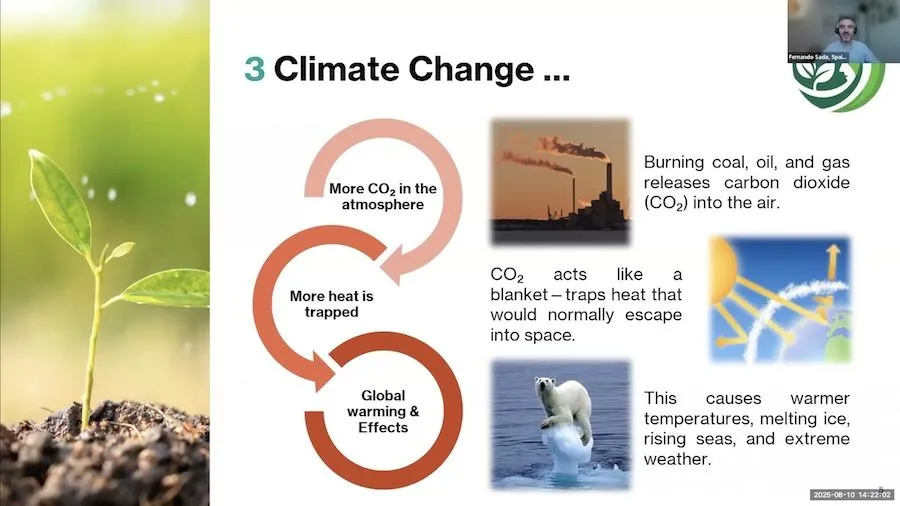
Throughout his comprehensive presentation, he first recalled what climate change is and the harmful effects of CO2 on the planet. Eighty percent of the world's energy still comes from fossil fuels, which are the main cause of CO2 emissions. These emissions not only affect nature but also people, especially the poorest. 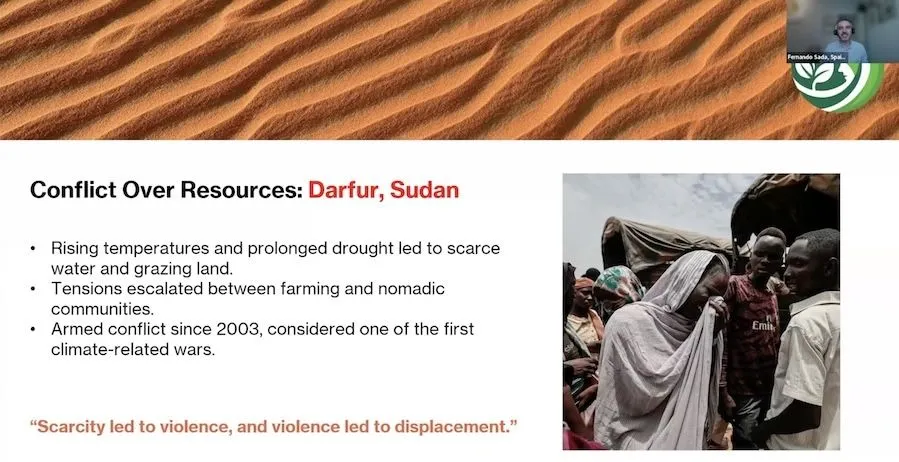
He gave some examples of this, such as the case of Darfur, a region in western Sudan where rising temperatures and prolonged drought have led to water shortages and desertification. This has led to increased tensions between farming and nomadic communities. The armed conflict of 2003 is considered one of the first climate-related wars.
He then mentioned other cases, such as Typhoon Haiyan, which struck the Philippines in 2013, killing more than 6,000 people and from which poor communities have not yet recovered.
Energy transition
He offered some interesting facts, such as: 1 in 10 people do not have access to electricity and that rich countries use 10 to 50 times more energy per person than poor countries, yet it is the latter that suffer the worst consequences of climate change. At this point, he recalled a quote from Pope Francis: “True progress must include everyone.”
To avoid these inequalities, Fernando Sada believes that a clean, inclusive, fair, and equitable energy transition is necessary. This involves “reducing fossil fuels, expanding renewables, ensuring affordable access, and creating decent jobs.”
He then explained the advantages offered by renewable energies and focused specifically on describing offshore wind power, which captures the energy of the wind at sea.
In the last part of his presentation, the engineer referred to the social and ethical impact of this reality, emphasizing that “as Christians we are called to bring light, not only electricity, but hope.” 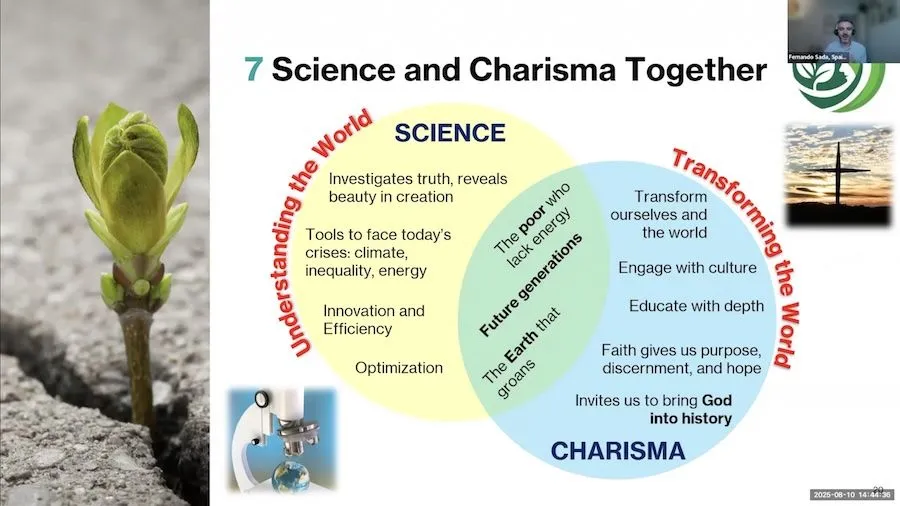
Science, charism, and action
He then explained why science and charism go hand in hand. “The former gives us tools to understand reality, solve problems, and build knowledge. The latter transforms that science with faith, education, inner growth, and cultural dialogue. Our charism must guide science toward peace and justice.”
“Let us move forward with a strong, enlightened, and active faith,” said Poveda, words that remind us of the need to take action. Before taking that step, we can ask ourselves certain questions. According to Sada, some of these could be:
What gifts has God given me to care for the Earth?
Where do I see unjust energy use?
What am I willing to do?
Regarding the last question, the engineer suggests speaking up and talking openly about climate and faith in our communities, workplaces, schools, etc. “We must choose responsibly, support clean energy, and reduce consumption. It is also important to help others, to accompany those who suffer most, the most vulnerable. Let your science, your faith, and your voice shine for the Earth and for peace.”
At the end of the meeting, there was time for dialogue, during which attendees asked a variety of questions, gave their opinions, and some expressed their concerns about renewable energy and its implementation in certain countries.
The second online meeting will take place next Sunday, September 14, from 2:00 p.m. to 3:35 p.m. (CEST). Elisa Estévez, who holds a degree in Biblical Sciences and a doctorate in Theology, is a teacher and researcher, and will be giving the lecture entitled “Hearing the cry of creation: The ecological wisdom of biblical traditions.”
Full video of the first online meeting of EIJIT Assisi 2026.
TA Info.
TA Translation Team.
 Published in News
Comments will not be posted automatically, they are subject to moderation.
The email address WILL NOT BE VISIBLE in the comments section.