



He was born in León on 6 May 1916. He was educated at the Carmelitas de la Caridad school in the city. In 1931, he began his university studies in Madrid, where he came into contact with Don Pedro Poveda and the Teresian Association, an organisation founded by him and already well-established, to which he lent his unconditional support.
She was one of a group of young female university students who studied at the Teresian Association Hall of Residence on Calle de la Alameda in Madrid. In those turbulent years leading up to the Civil War, as well as studying and achieving top marks, she played an active role in the Catholic Students’ Associations promoted by this institution.
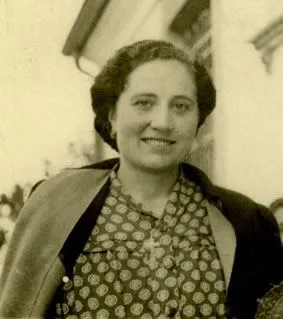 Once the Civil War was over, she began a PhD in Chemistry in Madrid, which she would complete in Rome, a city she reached in 1941, in the midst of the Second World War, to continue her work with the Teresian Association, and where she lived until 1960. From her early years in Rome, she often recalled the profound experience of welcoming groups of Jews sent by the Vatican into her home, to facilitate their journey to Spain as a stopover on their way to various countries in Latin America. From this period in Rome, Ana María retained a deep connection with the Church through its Vatican representatives, which she would later pass on to generations of young female university students who received her guidance and support at the Institution’s study centre in Madrid—which she directed and which later became the Colegio Mayor Josefa Segovia.
On her return to Spain, Ana María managed to balance her role as Secretary-General of the Institution and her directorship of the aforementioned centre with intensive work on the Episcopal Commission for Education. This work enabled her to serve as a member of the National Council for Education, where she had the opportunity to significantly promote vocational training and participate in a World Bank programme to fund reforms in education, following the 1970 Education Act.
Ana María spent the 1970s mainly collaborating with and encouraging the people and activities of the Teresian Association in three countries in the Americas: Argentina, Chile and Uruguay. She was deeply moved by the Chilean revolution, gaining a clear understanding of the social and ecclesial realities of the Southern Cone of the Americas. On her return, she had launched a new inter-American magazine in Argentina, *Nuevamérica*, which is now published in Brazil.
In the ecclesial sphere, Ana María was the first woman to be invited as a speaker at a Plenary Assembly of the Spanish Bishops’ Conference. This took place in 1970, and the topic she addressed was entitled ‘Ignorance as Poverty’. She promoted the adaptation of catechesis to the guidelines of Vatican II. It was as a result of this ecclesial service that she launched, at the Teresian Association, a wide-ranging movement for the formation of educators in the faith, first establishing the Jaris Institute and subsequently a foundation of the same name.
She devoted her final active decades, the 1980s and 1990s, to promoting the great figure of Teresa of Ávila. To mark the 4th centenary of her birth (1981), she worked tirelessly as a lecturer and writer, promoting and facilitating understanding of, and access to, the writings of the Saint of Ávila.
She returned to León, where she spent her final years and where she passed away in January 2010.
Her long life, which links back to the early stages of the Teresian Association, and her recent death, make Ana María López a bridge between the ‘First Generations’ and the rest of the story. A story that is presented here through her publications.
We present a selection of Ana María López’s writings and published works.
She was a major contributor to *Eidos*, a “magazine edited and produced solely by women”, in which she wrote on pressing issues in education; these articles were published as offprints: “Vocational Training for Women” (1958); ‘Moral and Legal Problems in the World of Women’s Work’ (1961); ‘Trade Unionism’ (1965); ‘Those Marginalised by Culture: Ignorance, a Form of Poverty That Must Be Combated’ (1970).
The Narcea publishing house has published much of her research on the life and works of Saint Teresa of Ávila: “Teresa of Ávila. Friendship with God’, in collaboration with Pilar Alastrue, Madrid 1970 and 1981; ‘The Experience of Faith in Teresa of Ávila’, Madrid 1981 and León 1982; ‘Love and Freedom in Teresa of Ávila’, Madrid 1986.
On the same subject: “A Woman’s Face. The Human Personality of Teresa of Ávila” in *Revista Humanística y Teología*, Oporto 1980; “The Personality of Teresa of Ávila”, in *Revista de Teología Espiritual* no. 77, Madrid 1982.
She has also published several works on Mary, the Mother of Jesus: “Mary, Mother of God, a Woman of Faith. Catechesis on the Virgin”, 6 bound instalments, Spanish Episcopal Conference, Madrid 1979; “Mary, the woman of faith”, *Jaris* No. 1, Valencia 1980; “Mary and women”, *Jaris* No. 9, Valencia 1984; “A Christian Way of Living Mary’s Presence”,“Ephemerides Mariologicae”, Vol. XLII, Madrid 1992.
On various topics: “Ecclesiastical Reluctance towards Women”, in the July–August 1982 special issue of “Communio”, pp. 246–260; “A Meditation on the Dignity of Women”, *Teología en Diálogo* 2, pp. 121–156, Salamanca 1989.
In his latest book, he reveals an interesting and lesser-known aspect of Poveda: *Blessed Pedro Poveda and the Brotherhood of the Refuge*, Narcea S.A. de Ediciones, Madrid 1995.
Contributed by AHIT
Comments will not be posted automatically, they are subject to moderation.
The email address WILL NOT BE VISIBLE in the comments section.