



The Plaza de la Concha Cultural Centre run by the Teresian Association in Cordoba in Spain held two meetings on the synodal process in online and in-person format.
The speakers were Consuelo Vélez, a theologian and member of the Teresian Association from Colombia who teaches at the Javeriana University of Bogotá, and Amelia Sanchís, professor of State Ecclesiastical Law at the University of Cordoba and expert in gender studies. Their reflections were followed by active exchange. Maria Luz Ortega, ACIT member, acted as moderator.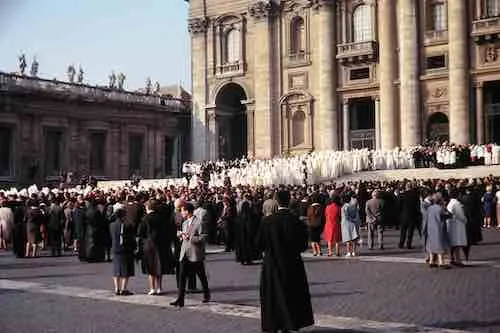
St Peter Square, opening of Council Vatican 2
Synodality at the beginning
At the first meeting at the end of January, Dr Vélez addressed the theme of the theological roots of synodality which she demonstrated were to be found in biblical and patristic sources. The Church originally was open and inclusive, and this included women as well. St Cyprian, in the 3rd century, maintained that in matters that concern everyone, everyone must be involved in making the decisions. At the Second Vatican Council, this feature of the Church’s identity was recovered and the model of the People of God appeared. Pope Francis is taking this up again in convening this new synod. Consuelo Vélez emphasised the importance of looking back to the past and discovering the liberating features of the Church in order to put them into practice today.
She identified the theological foundations of synodality as follows:
- The Church has its origin in the Trinity which is community and communion. To recover this Trinitarian foundation is to reclaim the dynamism of the Spirit which is to move forward, be daring and to accept new things...
- The Church is the people of God who journey in communion. They are laity and clergy whose primary sacrament is baptism. This implies a repositioning of the hierarchy where it is no longer seen as the holder of power. The sensus fidei (sense of faith) has its roots in the whole people of God. All of us are seated at the same table with our different charisms. Hence the insistence on the need to break with clericalism.
- The Church must be one of outreach that dialogues with everyone including those who are outside and with the contemporary world without fear of using the language being employed by society today.
Dr Vélez pointed to some of the characteristics proposed in the synod preparatory document. She said that there may be doubts as to whether a change proposed from the top down will work. Beyond the contributions that will reach the synod, the progress made in each local church is important. As the Pope says, we must avoid the dangers of intellectualism, formalism and paralysis. She concluded by saying that this is an opportunity to rekindle the hope that the Church will become more like the Church of Jesus. This was followed by open discussion on topics that included the need for the laity to be educated about this and the identification of inclusive channels of participation.

An opportunity for equality
On 19 February, Dr Amelia Sanchís addressed the topic of the impact of the synodal process on the gender dimension. She began by saying that if terms such as feminism or gender make the Church uncomfortable, this would diminish the possibility of building and incorporating the contribution of women who are citizens with rights and duties in today’s society. She alluded to the fact that in the Pope’s call to break with clericalism, synodality is a way to rebalance the ministry-community equation with an ad intra circular dynamic and a call to build bridges ad extra. Throughout history women have been able to weave networks with effective results. After her introduction, Dr Sanchís gave a historical overview with the aim of identifying what women can contribute to synodality.
She pointed out how, in addition to the inequality existing between men and women, there was the fact that, from the 4th century onwards, the primacy of male-only ordained ministries increased. This meant that women were left out of power. From the beginning of the 20th century, women led many of the movements of the faithful that were demanding a place for the laity. Pius XII and John XXIII took some steps towards the equality of men and women in the Church up to the Second Vatican Council. At the Council there were affirmations of fundamental equality that were not always reflected in the documents. Although the 1983 code of canon law brought about an important change in relation to the previous code, it still does not provide for equal rights.
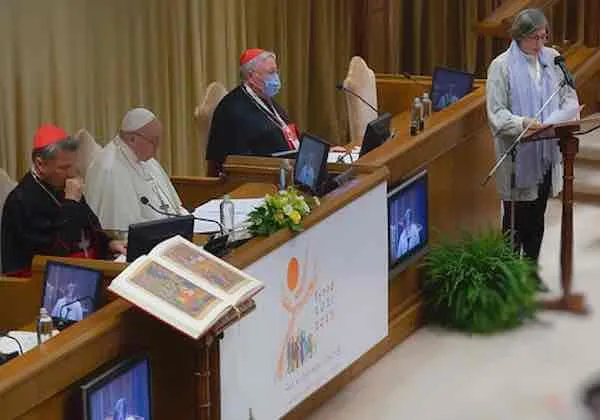 Dr Sanchís suggested, with a sense of humour, that we practise “the inversion rule” and ask what men would say if they were treated as women have been treated. In the proposed listening process in preparation for the synod, it would be good to ask men to imagine themselves in the place of women.
She went on to give some data on the participation of women in the synodal process. For the first time a woman will have a vote. A religious sister from France, Nathalie Becquart, was appointed under-secretary of the Synod of Bishops, and this is a new step taken by Pope Francis on the road to the incorporation of women into positions of responsibility in the Church. In the synod commissions the ratio is still unequal, except for the one on methodology.
She went on to suggest that we should not lose sight of the reflection that is taking place in different countries on what women want to do in the Church and what steps to take. She mentioned the Conference of Major Superiors, the Association of Spanish Women Theologians and the Revuelta de mujeres en la Iglesia [Revolt of Women in the Church] as examples of organisations that are currently on this path. Before moving on to open discussion, she suggested a test of shared responsibility and gender with several items that could be used to help us to become aware of whether or not women are participating in the organisation of the synodal process at local level.
At the end of the discussion, the aspiration that filled the air was one for rights, and the hope that dominated was that synodality may be able to open new windows.
Estrella Sendra, Córdoba.
TA Translators Team.
 Published in Synodal Journey
Comments will not be posted automatically, they are subject to moderation.
The email address WILL NOT BE VISIBLE in the comments section.