



With a view to reinforcing the initiative “Renewing our commitment to education” set out in the first mission priority of the Teresian Association (2023–2028), the Council for Culture organised an international seminar in Santa María de Los Negrales in Spain on this topic. It was in this context that João Costa, Chair of the Committee on Educational Policies and of the OECD’s Global Forum on the Future of Education and Skills 2040, as well as Director of the European Agency for Special Needs and Inclusive Education, delivered his lecture.
The Council for Culture’s International Seminar, ‘Education: the foundation and driving force for social transformation and full humanisation’ (21–29 July), aims to reflect on various educational issues and inclusive education. Within this framework, a lecture entitled “Some Global Challenges Facing Education Systems” was delivered, in which João Costa, Portugal’s Minister for Education from 2022 to 2024, not only outlined the general challenges facing the current education sector but also placed particular emphasis on inclusive education.
Lurdes Figuieral da Silva, a member of the TA Council, introduced the speaker, and Inmaculada Balfagón, chair of the TA Council for Culture, thanked him for taking part in the seminar on behalf of all its members.
In the first part of his talk, the speaker set out the context of the current situation in education. He began by emphasising that education is undergoing a major process of transformation, although the pace of this change is too rapid, and this has negative repercussions for achieving a high-quality education system. 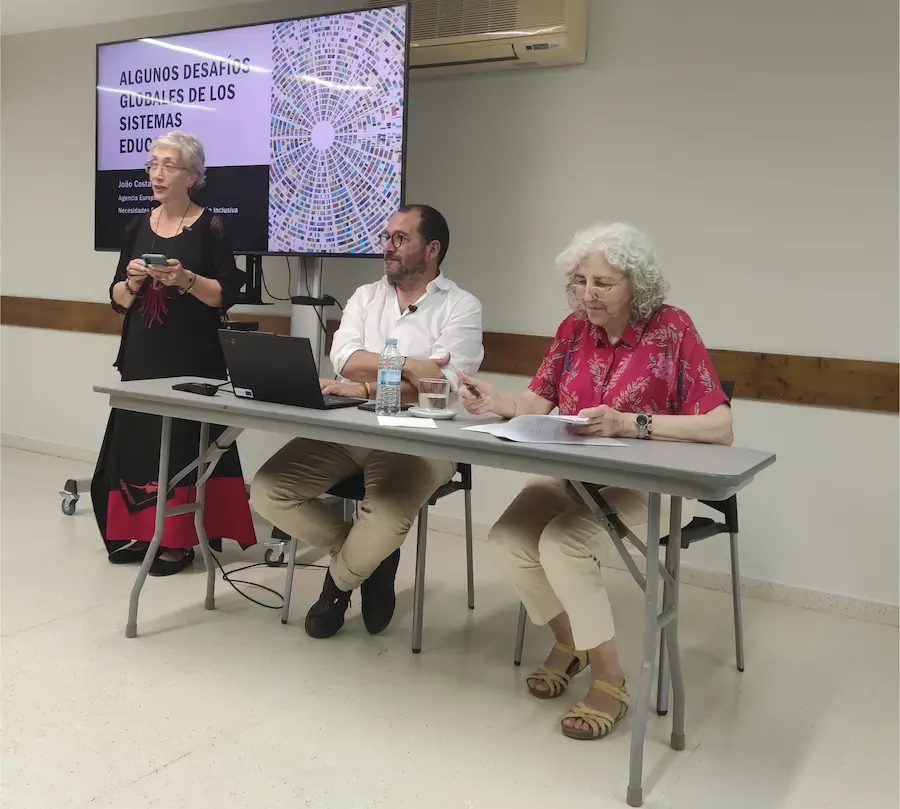
He then analysed the challenges currently facing education, such as new technologies, education policies and the impact of wars, amongst others. With regard to Artificial Intelligence, he stated that, in his view, it can be a supportive tool, but not one for “delegating tasks”. In this regard, he emphasised that it is important for creativity not to disappear – something that appears to have been happening strikingly among young people in recent years. “Creativity and humanism must always be present in education,” he asserted, just as they are in other areas.
He outlined the key priorities of the Organisation for Economic Co-operation and Development’s (OECD) in the field of education. He spoke of the social and economic benefits of education – which are increasingly undervalued – as well as cognitive and socio-economic skills, lifelong learning and the role of innovation. He emphasised that the organisation has found there to be a clear positive correlation between levels of qualification, quality of life and active citizenship; he therefore asserted that “education can safeguard the quality of democracies”. He also highlighted the need to develop emotional and functional skills.
He added that teacher training must change and adapt to new technologies, and also referred to the decline in the number of people entering the teaching profession. Key challenges for these professionals are the importance of curriculum design and what is to be offered to pupils as a key challenge for these professionals.
The future of inclusive education
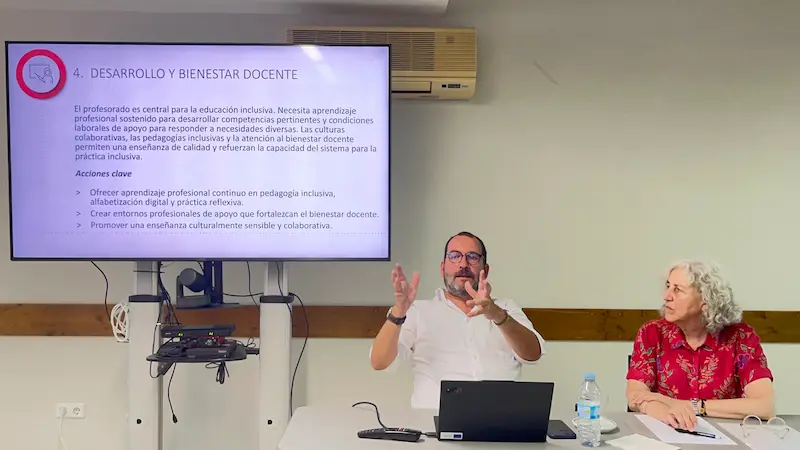
In the second part of the meeting, João Costa focused on inclusive education and the ten pillars that will shape its future, many of which had already been mentioned in the first part:
- Pupils’ wellbeing and sense of belonging: here he spoke of issues relating to access to education, but also of support for mental health, nutrition and digital literacy.
- Family and community planning: the importance of strengthening partnerships.
- Lifelong learning: with specific policies tailored to each stage of life.
- Teacher development and wellbeing: he emphasised the need to incorporate practical experience into teacher training.
- Innovation in curriculum and assessment: incorporating inclusion and developing interdisciplinary, future-oriented curricula.
- Digital transformation and AI: the importance of a human-centred approach was repeatedly emphasised.
- Cross-sectoral collaboration: integrating diverse services and strengthening multi-professional teams.
- New forms of governance and leadership: developing leadership skills.
- Quality assurance and monitoring: through evaluation mechanisms and sustained, equitable investment.
- Strategic funding and resource allocation.
He concluded with a call to action: “Inclusive education requires a paradigm shift and collective responsibility.” The event ended with questions from the audience, and this turned into a forum for dialogue where different viewpoints on the current state of education were put forward.
Watch the full presentation in the video below:
TA Info.
 Published in News