



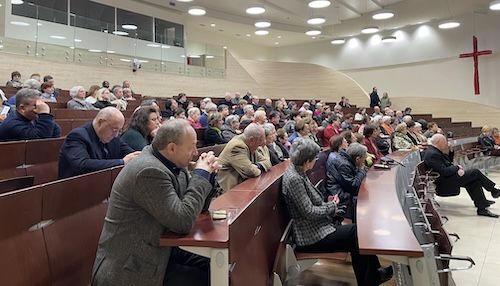
The celebrations marking the centenary of the pontifical approval of the Teresian Association were formally concluded in Rome on Friday 31 January 2025 with a conference in the Gregorian University Aula Magna. The year of celebrations had opened in Madrid on 12 January 2024.
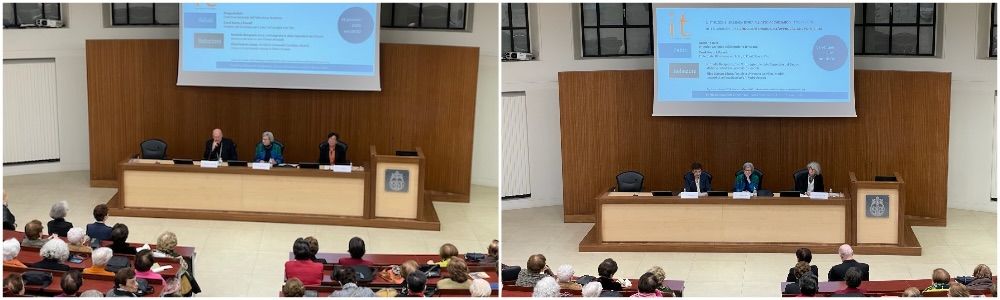
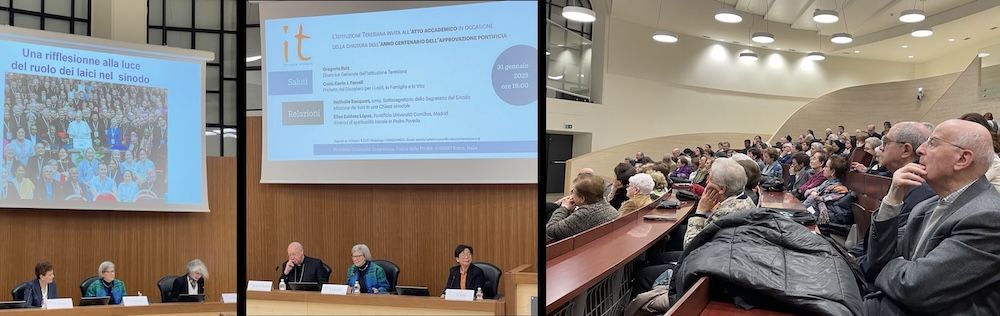
The event was chaired by Dr Francesca Cocchini, and it began with opening remarks given by the president of the Teresian Association, Gregoria Ruiz, and the prefect of the Dicastery for Laity, Family and Life, Cardinal Kevin J. Farrell.
This was followed by the presentations given by Nathalie Becquart, xmcj, under-secretary of the General Secretariat for the Synod, who spoke on ‘The mission of the laity in a synodal Church’ and by the theologian Elisa Estévez López, on ‘Itineraries of lay spirituality in Pedro Poveda’.
Contemporary and attractive
‘We come today with grateful hearts for all that we have received and experienced during this past year of celebrations for the centenary of pontifical approval that were held wherever in the world the Teresian Association is present... We have been given the gift of experiencing and rediscovering the relevance and attractiveness of our mission-vocation. We desire to make known and to share this treasure -- the charism we have received, one that is made up of a diversity of associations and members’ commitments ... This charism was recognised by the Church for its innovative and attractive nature’, said Gregoria Ruiz. She also emphasised how much we welcome the synodality in the Church of our times and the fact that it coincides with the Jubilee year with its call for us to renew our hope.
The power of a charism
Cardinal Farrell followed with a warm greeting in which he spoke of some characteristics of the charisms given by the Spirit and on their potential which develops over the course of time. ‘In this centenary year, you too must be very aware of this: the charism that God has given us retains a vital force that does not come from us; this vital force flows from God, and God always moves to draw people closer, to renew the Church, to let us experience the redemption and salvation that Jesus accomplished once and for all, but which must be felt in every soul, at every stage in history’.
 The cardinal also made reference to how the charism of the Association is directed towards the education of young people. He drew a parallel between St Pedro Poveda and St John Bosco, whose liturgical feast was celebrated that day. ‘To train educators is a great undertaking that requires wisdom and love. It is an art. It is a human and a supernatural endeavour at the same time... It is a task that you must take on with commitment and very seriously,’ he said.
Conversion to synodality
Sister Nathalie Becquart, xmcj, then spoke. She said that ‘synodality evolved from a vision that emerged from the Second Vatican Council’. She gave an overview of the final document of the synod and highlighted aspects that were discussed in which the mission of the laity is made more explicit. Pope Francis has decided that this document is to form part of the magisterium, and this is something new. Sr Nathalie emphasised that the guiding thread of the document is conversion. She discussed this theme and provided several concrete examples. ‘At the heart of the synodal dynamic is the baptism that unites us; there is nothing greater than this dignity,’ she said, stressing that a synodal Church is a missionary Church.
Holiness in the world
SElisa Estévez López presented ‘Itineraries of lay spirituality in St Pedro Poveda’. These are paths that bring together ‘the pursuit of holiness and everyday life in the world’, a ‘spirituality with its own special touch that can nourish and light up the path of the laity in today's society’, she said. The model for this is the life of the early Christians, as outlined by Poveda in his various writings, following the New Testament and especially the Letters of St Paul. The centrality of Christ and the values of meekness, humility, charity, etc., and to be like leaven in the world, are brought to the fore. Dr Estévez engaged with Poveda from the perspective of the present time. She could only present some of the itineraries due to the limited time allocated to the presentation. She left open the possibility of other possible itineraries of Poveda’s texts done in this way grounded in the present time.
The full recording of the event provided by the Gregorian University is available here.
Info TA.
TA Traslation team
 Published in News
Comments will not be posted automatically, they are subject to moderation.
The email address WILL NOT BE VISIBLE in the comments section.