



The Second International Congress on Humanising Education in the Digital Age, organised by the Pedro Poveda Academic Chair at the Pontifical University of Salamanca (UPSA), was held in Salamanca in Spain from 5 to 8 February.
The congress addressed highly topical issues such as the emergence of artificial intelligence (AI) in education; the various challenges of digitalisation and the omnipresence of technology in the classroom; and anthropological, philosophical and pedagogical issues related to the above, based on a humanistic approach to education.
An ecclesial perspective of AI was also presented. In keeping with the title of the Chair, key aspects of Pedro Poveda's educational and humanistic vision were given and provided insights for this debate.
The Congress concluded with a final document presenting three challenges focused on providing education that contributes to ‘the flourishing of an authentically human life’ at this time of digital-technological explosion. The document can be downloaded here.
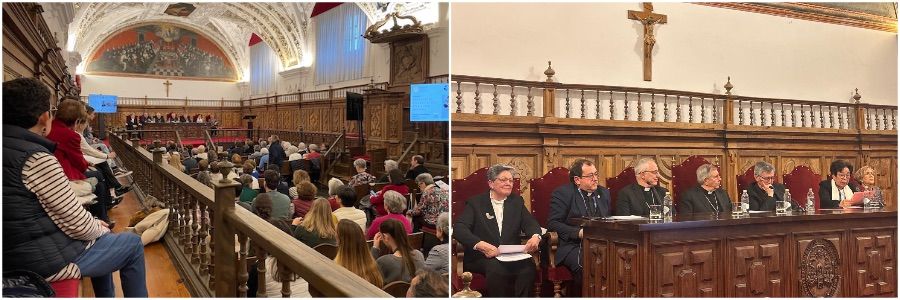
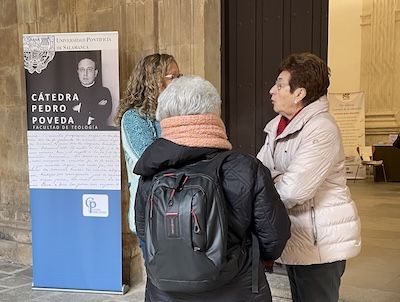 After a solemn opening ceremony in the historic Aula Magna of the UPSA, the Congress was structured around five presentations, two round table discussions and three panels. The participants, who numbered around 180, were able to offer their opinions and contribute to each paper through a digital tool set up for the occasion. There was also an afternoon dedicated to the presentation of communications.
Alfredo Marcos, a philosopher and professor at the University of Valladolid, opened the debate with a talk entitled ‘Forms of humanism and transhumanism -- philosophical challenges'. This laid the anthropological foundations of the debate: the person at the centre, dignity, the common good and the search for virtues – that go beyond values--, keys to the development of human beings in this digital era.
This first day of the Congress concluded with a concert by the UPSA's Tomás Luis de Vitoria Choir. According to its director, Francisco J. Udaondo Puerto, music is always conducive to experiences that humanise and create communion.
A point of convergence
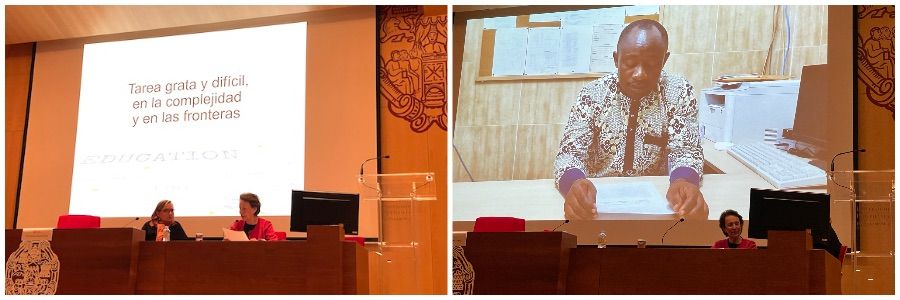
On the second day, Aránzazu Aguado presented a very broad pedagogical framework full of references in line with Pedro Poveda's vision. She cited various educational experiences that foster human ‘flourishing’. She suggested that communication can be a ‘solid point of convergence’ between the pursuit of humanisation and the digital world. She referred to a writing by Pedro Poveda in 1932 that says -- ‘I ask you for a new system; a new method, procedures as new as they are old, inspired by love’. She urged us to move away from routine ways of educating and to explicitly aim to humanise and to support the diversity of the learners as they ‘embrace hope and love’.
To complement this, young educators from the Dominican Republic, Equatorial Guinea, the Philippines and Spain who are in contact with Poveda's pedagogy, responded by video to two questions posed by the speaker.
A vocation to educate
Panellists at the round table discussion on ‘Today’s educators and current challenges’ coordinated by Raquel Osorno, included Luis Sierra, teacher at the TA Castroverde School in Santander; Enrique Revilla, teacher at the Isabel Flores de Oliva Centre and at the University; and Marta de los Ríos, a young teacher at the TA centre in Cordoba and participant in ‘Youth for Education’. They presented key elements of the vocation to educate, how to build day-to-day commitment, the impact of new technologies on teaching and teachers, how to take care of oneself and sustain the pressure of ‘continuous learning’. Other reflections focused on ‘support structures’ to take care of oneself as a teacher and to keep on top of things, and how to figure out today’s very complex circumstances that can overload and challenge teachers.
 Perspectives
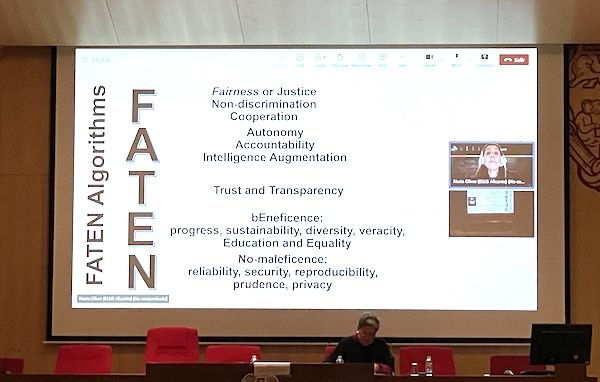
Nuria Oliver, one of the international experts on AI, addressed the Congress remotely from Alicante, Spain. She gave insights into the development and future of AI and its impact on society and education.
Following this speaker, Mercedes Blanchard coordinated a round table discussion on teacher training in which experiences were offered on the use of AI in the classroom.
The fourth presentation, entitled ‘The challenges and opportunities of emerging forms of learning: technologies for an inclusive school in the digital age’, was given by Rosario Fernández, an engineer and expert in the digitalisation of school environments. She showed AI tools currently in use and also the challenges they pose and how to face them. She advised improving digital literacy; learning to detect the manipulation of information; establishing diversity standards; training people to be conscious and critical moral individuals.
This was followed by two panel discussions on the contribution of the Church. It was connected to Rome from where Monsignor Renzo Pegoraro, Chancellor of the Pontifical Academy for Life, presented the recent contributions of the pontifical magisterium to the debate on AI. Next, a group of five young people, coordinated by Maria Dolores Valencia, presented educational experiences related to the digital world. We highlight the EDIW e-Bridge project, which offers support to disadvantaged schoolchildren in various countries with a volunteer network of young Europeans and Filipinos.
There was a third panel discussion on the last day coordinated by the dean of the Faculty of Theology at the UPSA, Román A. Pardo, and with lecturers from the same university, Alfonso J. López Rivero and Almudena Duque Sánchez. It dealt with ethical and psychological perspectives on digitalisation and AI, with examples of their biases and the need to supervise their use, monitor their effects and learn to disconnect. 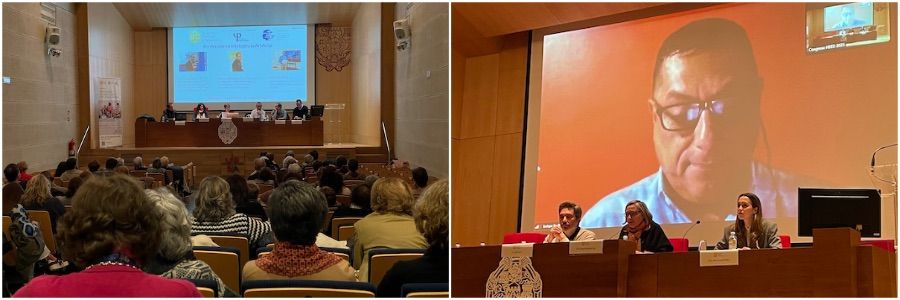
The closing presentation of the conference focused on the anthropological keys that Pedro Poveda believed would open up ways for humanisation in the digital age. The theologian Elisa Estévez López gave an overview of relevant writings of the founder of the Teresian Association. The triad ‘faith, science, virtue’ is essential, she said, to understand his humanising vision, as well as an understanding of the Incarnation.
This is a journey of faith that is guided by the Crucifix. Poveda sees that the intellectual, the ethical and the aesthetic come together in Christ crucified. Christ is a transforming force and a source of truth that is not revealed by accumulating data but by ‘contemplating the love that gives itself, the charity that redeems’. The challenge of humanising education in this digital age highlights the importance of discernment. Here Estévez stressed the value that Poveda gives to ‘examination’ and how we must be aware and appreciative, and also to take some distance, to gain the freedom to choose and decide how we use our intelligence. 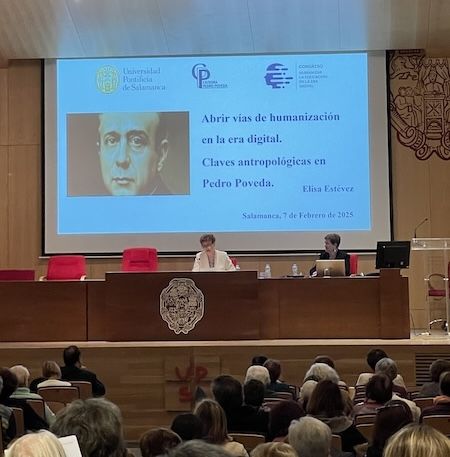
Challenges
At the closing of the Congress, the above-mentioned challenges were presented as a task and a starting point for further reflection. The publication of the papers and communications, announced by the organising committee, will facilitate the complete reading of the presentations and their dissemination.
As the president of the Teresian Association, Gregoria Ruiz, pointed out at the opening of the Congress, ‘We share an enormous and exciting challenge which is to understand what our unique capabilities are as human beings in the digital age. These capabilities involve others and the transformation of our society, so that it may become truly human, in accordance with God’.
The Pedro Poveda Academic Chair at the Pontifical University of Salamanca (UPSA) is a TA initiative in Spain created on 28 July 2000. Currently, the TA representative to the Chair is Maria Dolores Peralta Ortiz.
Info TA,
TA Traslation Team.
 Published in News
Comments will not be posted automatically, they are subject to moderation.
The email address WILL NOT BE VISIBLE in the comments section.