



The Teresian Association stands in solidarity with the people of Colombia and shares in their suffering during this difficult time following the recent earthquake. Olga Consuelo Vélez sends us updates and information from Bogotá.
We had only just experienced ‘the earthquake’ (painful and devastating) of the presidential inauguration of the new president, Abelardo de la Espriella, who represents a shift to the ‘far right’ and the negative consequences this brings for a country in urgent need of social justice, when on Monday 10 August at 7:34 am, we were struck by a 7.4-magnitude earthquake.
The epicentre of the earthquake, which lasted almost two minutes, was San José del Palmar in the department of Chocó. It was felt across much of Colombia and neighbouring countries, causing widespread destruction and loss of life, and triggering a humanitarian crisis. This is a situation that we must now address in this stricken Colombian region.
The death toll is rising by the minute as the full scale of the tragedy becomes clearer. More than 265 people have died, 3,494 have been injured, 500 are missing and 53,816 people have been affected. A total of 1,136 homes have been reduced to rubble and 257 buildings have collapsed in various cities across Colombia, particularly Cali, Pereira, Quibdó, Manizales, Buenaventura and Popayán. More than 357 municipalities have been affected, spread across 13 departments. Damage has been confirmed to 796 educational establishments, 84 healthcare centres, and 129 roads. Hospitals in Pereira, Cali, and Quibdó are operating at full capacity. Public services, such as electricity and water, have been suspended and are only now being slowly restored – quicker in the major cities and slower in rural areas..
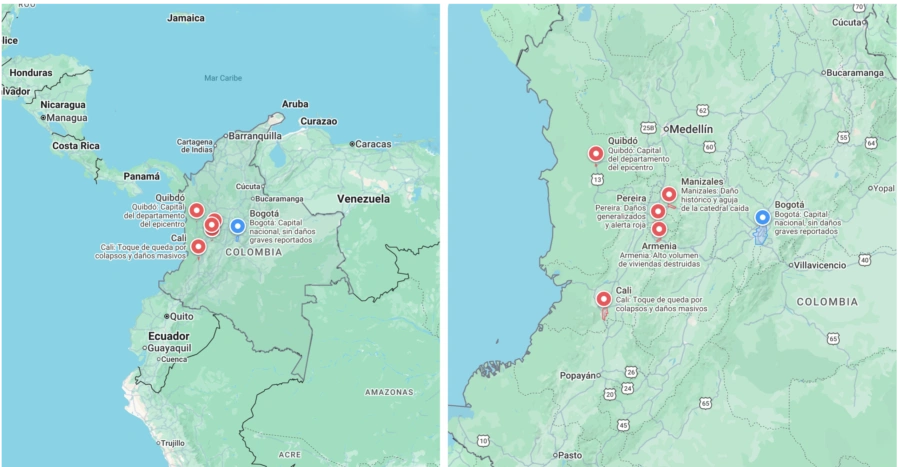 Epicentre of the damage: Maps (at scales of 200 and 50 km) showing the towns and cities most affected by the magnitude 7.4 earthquake.
The red markers indicate the regional capitals facing humanitarian and structural crises. (Produced in-house using AI).
Stories
There are many eyewitness accounts, all of which illustrate the scale of the tragedy and the suffering it has caused.
- A couple in Cali: “We said our goodbyes; we thought we were going to die there because it was so intense. We managed to get out with our little dog and met up with our neighbours in the park.”
- A 22-year-old young man in Pereira:“I was at the gym when the tremor started. I helped evacuate several people and when I returned to my block, everything was destroyed. I only managed to salvage my mobile phone and the clothes I was wearing.”
- A young volunteer in Quibdó: “The child’s death really shocked me… he was so small and we couldn’t get him out alive. It was devastating.”
- A man from Pereira: “Our flat collapsed on top of us; we only just managed to get out. I was holding my one-and-a-half-year-old daughter in my arms –it was terrible.”
There are also many tragic stories, such as that of a 10-year-old girl and her grandmother in Cali who were both trapped in a collapsed building. After more than 24 hours, their bodies were found. Neighbours recounted: “We could hear their voices calling for help, but we couldn’t reach them in time.” Another story is that of the 32-year-old woman in Pereira who was rescued after 36 hours. However, her condition is critical, and she will likely have to have an upper limb amputated if she survives.
Solidarity
Although the government declared a national emergency, there has been a lack of organisation and ideological considerations, which have slowed down the necessary response and delayed aid from abroad. Nevertheless, the solidarity shown by many countries is admirable, as is the generosity, commitment and resilience of the Colombian people. They are doing everything they can to respond to the great need they are facing. Indeed, it is in extreme situations that the best in human beings is brought out, and we are witnessing this in the many acts of solidarity where creativity, dedication and hope become a transformative force.
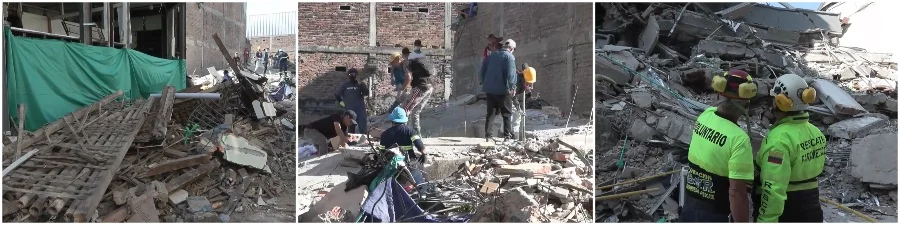 Snapshots from videos on social media.
Resilience
Regarding members of the Teresian Association, we are all well and have not been directly affected by the earthquake, as Bogotá was not impacted. However, one TA member living in the Department of Chocó, although she was not directly affected, is experiencing this tragedy first-hand, witnessing how this department –once again– suffers not only as a result of natural disasters, but also from historical neglect. This neglect –to which the Department of Chocó has always been subjected– in situations such as this, highlights this ‘other’ forgotten Colombia, which the current government has no interest in prioritising.
The earthquake has left devastating consequences in its wake, as well as deep emotional scars. The stories of survivors reveal a country's fear, loss and resilience. Amidst the pain, Colombia is seeking to rise from the rubble and face adversity head-on.
Olga Consuelo Vélez, Bogotá.
Original text in Spanish.
 Published in News
Comments will not be posted automatically, they are subject to moderation.
The email address WILL NOT BE VISIBLE in the comments section.