



The third online session of the Teresian Association International Youth Meeting (EIJIT) took a trip back in time to look at modern armed conflicts in recent history and their connection to human rights.
On 22 February, a very diverse audience from 16 different countries joined the online talk given by Marina Cardozo, lecturer and researcher at the University of the Republic of Uruguay. It was entitled ‘The Humanities for Peace: Reflections on Contemporary Armed Conflicts from the Perspective of History and Human Rights.’ It was the third online session of EIJIT 2026.
Historical overview
Although this is a very broad and complex topic, Marina Cardozo offered a comprehensive overview of the way in which the conflicts of recent times have shaped the peace that followed. She pointed out that when the peace achieved after these conflicts is poorly managed, it has led to more wars over time.
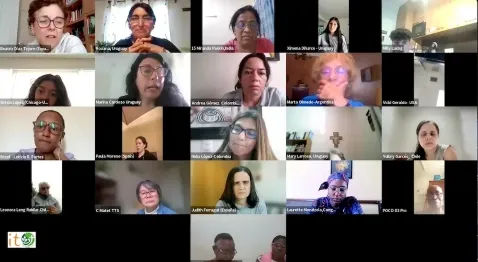 She began by reviewing the First and Second World Wars, their tolls and consequences. After the last Great War, it was said that it had been necessary to put an end to armed conflicts, something that did not happen because ‘the Cold War ensued, exacerbating all the existing conflicts’.
The speaker pointed out that in today's world, democracies are struggling to survive and authoritarianism must be curbed. If there is conflict, let it be ‘healthy’ -- ‘because while conflict is healthy, it is not healthy when it leads to war, and then the solution is always more complicated.’
Human Rights and Peace
She then spoke about the Universal Declaration of Human Rights, a document issued by the United Nations in 1948. Quoting the Jesuit Luis Pérez Aguirre, she pointed out that ‘it is necessary to extend the scope of human rights compliance to the rights of the ‘non-person’, not only in terms of action, but also in terms of acts of omission, because only then will we be seriously addressing the rights of the poor and their economic, social and cultural rights’.
He had spoken of the ‘urgent need for education in human rights as a preventive strategy to avert the violation of those rights,’ a view with which the speaker also agreed.
In her closing remarks, she highlighted how children around the world are suffering the consequences of these wars with ongoing violations of their fundamental rights. ‘We cannot allow an entire generation of children to become collateral victims of the uncontrolled wars that are ravaging the world,’ she said, quoting Catherine Russell, Executive Director of UNICEF.
Then the attendees were given the opportunity to ask questions and share their thoughts, further enriching this third online meeting.
Watch the video of the online session and add subtitles in your language.
Would you like to learn more about the Teresian Association International Youth Meeting? Click on this link.
TA Info
 Published in News
Comments will not be posted automatically, they are subject to moderation.
The email address WILL NOT BE VISIBLE in the comments section.