



In 2003, the Teresian Association launched the Guadix Centre, a socio-educational project in Barranca Yaco, a challenging and vulnerable neighbourhood on the outskirts of Córdoba (Argentina). Since then, it has become a key resource for local residents thanks to the services it offers, which are based on holistic education and health promotion, alongside a range of activities that address immediate needs.
One of the main objectives of this initiative “is to work on the children’s education by collaborating with schools, because the pupils do not have anyone at home to help them with their homework. In schools, teachers follow their curricula and some pupils fall behind. So, we help them with their homework and, although we have mixed-age groups, the person in charge of the room addresses each child’s specific difficulties,” explains Susana San Martín de Nis, the current coordinator of the Guadix Centre.
The children who benefit from this activity (around 60 last year) are in primary and secondary school, that is, they are aged between 6 and 17. “The main aim is to provide them with academic support, help them with learning difficulties and monitor their reading and writing skills,” adds Marta Olmedo, a member of the Teresian Association in Argentina.
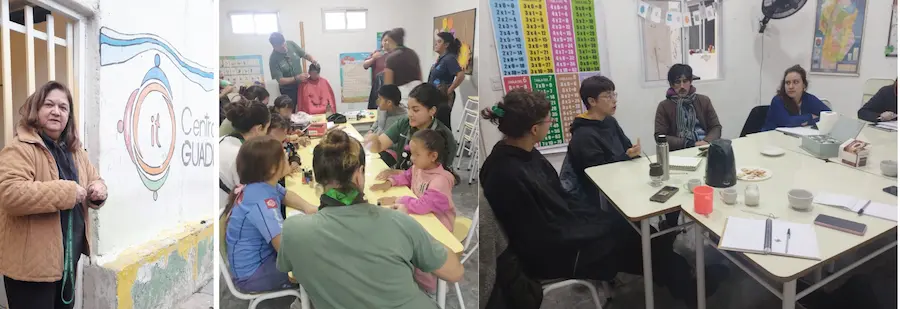
The paediatrician Susana San Martín de Nis became involved from the very beginning in this social project run by the Teresian Association, which is part of the Nuevamérica Foundation: “I first came across the Teresian Association in 2003, when it arrived in the neighbourhood and parish where I go. Marta Olmedo and other members of the Teresian Association, including its then-director general, Loreto Ballester, invited me to take part in something that was taking shape... So, from 2004 onwards, I began working at the centre as a paediatrician within the volunteering programme, visiting twice a week.”
In 2022, she took on the role of co-coordinator until she assumed full responsibility for this task, a role she continues to fulfil today, being able to devote more time to it now that she has partially retired.
Health
Another area of focus at the Guadix Centre is community health, where medical care is provided to local residents. In this regard, they treat patients with various infections and monitor vaccination schedules, alongside dental and eye check-ups, amongst other services.
Furthermore, the doctor explains that “some children, having been born in unhealthy environments, have suffered from respiratory problems since infancy and, as they grow older, develop bronchospasms and certain recurring conditions. We also see some gastrointestinal infections, skin problems, head lice and scabies”.
Another notable aspect of this area of work is the support provided for pregnancies, particularly high-risk ones, which is also overseen by Susana San Martín de Nis. “In this case, we aim to act as a link: on the one hand, pregnant women can come to see us via A&E or during our daily paediatric practice, and on the other hand, we offer them guidance—that is, we advise them on which public hospital to go to and help them understand the process so that it is easier for them.”
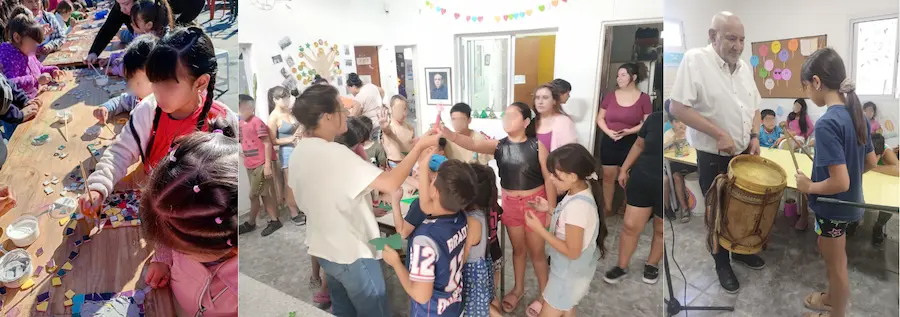
At the same time, as part of the support services aimed at women, personalised care is provided to those who have been victims of gender-based violence. “We provide support for women and mothers,” continues Marta Olmedo, “in terms of emotional support and accompaniment in situations of abuse. This year, we will begin working with them on all aspects of the communication network and community support.”
Speech therapy and various workshops
Equally important is the work carried out by speech therapist María Gabriela Acosta, who has been volunteering for three years: “Susana San Martín de Nis asked me to contribute my professional expertise, as I hold a degree in Speech Therapy. My area of work wasn’t initially defined, so we developed it step by step. We devised various programmes for the children, ranging from one-to-one sessions and work with parents, until we began working in groups or with the whole group, using a variety of approaches.”
The speech and language therapist explains that she works on literacy and language skills, whilst also monitoring progress – a task that can sometimes be challenging as it depends on how regularly the pupils attend classes. “The bond that develops is wonderful, and we’re trying out different strategies, adapting to the circumstances. We’ve held workshops both inside and outside the classrooms, in libraries… We’re trying out all sorts of things,” she adds.
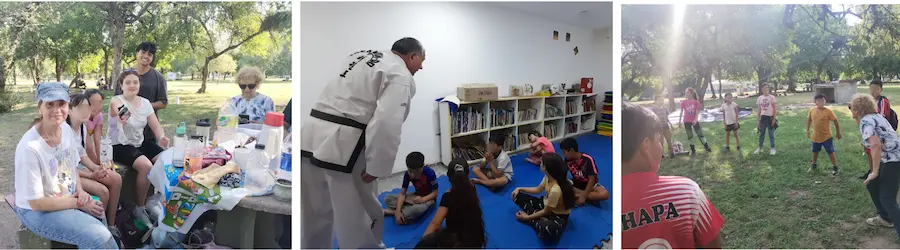
In addition, a variety of workshops on taekwondo, music, painting and more are offered on different days of the week. Marta Olmedo explains that “these workshops aim to strengthen relationships and communication skills, which are complex issues given the circumstances the children face. We also address environmental care through vegetable gardens, for example, and we even run literary workshops for children and teenagers. Throughout the year, we organise educational outings, taking them to the theatre or a museum…”
The Guadix Centre also employs two teachers, an educational psychologist and a doctor, alongside volunteers for the workshops. Thanks to agreements with several universities, they receive support from student teachers and medical students who come to undertake placements.
Volunteering and spirituality
For Susana San Martín de Nis, this experience is a way of living out the Gospel and of giving back to her country, Argentina, for the opportunity it gave her to receive an education by providing free university access: “For me, it’s a way of giving back what society gave me, as we all shape society and together we help ensure that others can receive an education.”
Speech therapist María Gabriela Acosta sees it from a different perspective, particularly because, for her, being part of this social project run by the Teresian Association is something completely different from what she has done so far: “Until now, I had worked in the disability sector at various centres, and this is something very different – a challenge and a huge responsibility. Wonderful. A beautiful place. I can’t describe it in a single word. There’s always something else to do. On a personal and professional level, I feel it’s a huge step forward. Spiritually, I feel very privileged.”
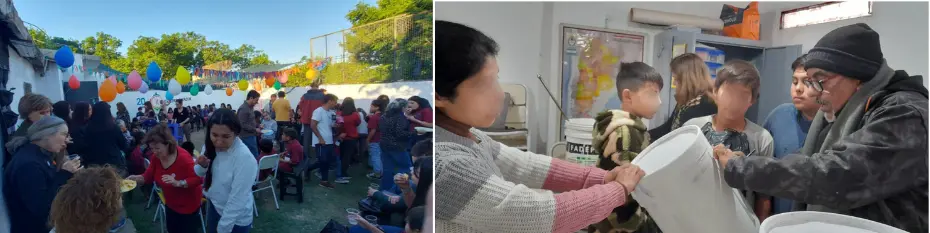
The Guadix Centre has been going strong for over 20 years; it is so well known in the area that there is hardly any need to advertise when its activities start each school year. Local residents pop in to ask if they see anyone inside, or find out via the WhatsApp group that has been set up, which helps reach the families who need it.
The new academic year in Argentina has just begun and there is a great desire to launch new initiatives. The aim is to resume workshops for women in a space they used to call ‘Coffee and Sharing’. Similarly, this year they hope to revive a psychological support service offering a welcoming and supportive environment for families and children, alongside other ideas they would like to launch. However, it is not easy, and although it has been running for over two decades, it needs resources, volunteers and all kinds of support to keep this great project—which puts Pedro Poveda’s philosophy into practice—going.
If you enjoyed this report and the great work carried out by the Guadix Centre in Barranco Yaco, Argentina, CLICK HERE and we’ll tell you how you can help.
Teresa Rey. TA Info .
Translation produced using AI tools.
 Published in News
Comments will not be posted automatically, they are subject to moderation.
The email address WILL NOT BE VISIBLE in the comments section.