



Conference in Holguín, Cuba, on the occasion of the Centennial of the Canonical Approval of the TA.
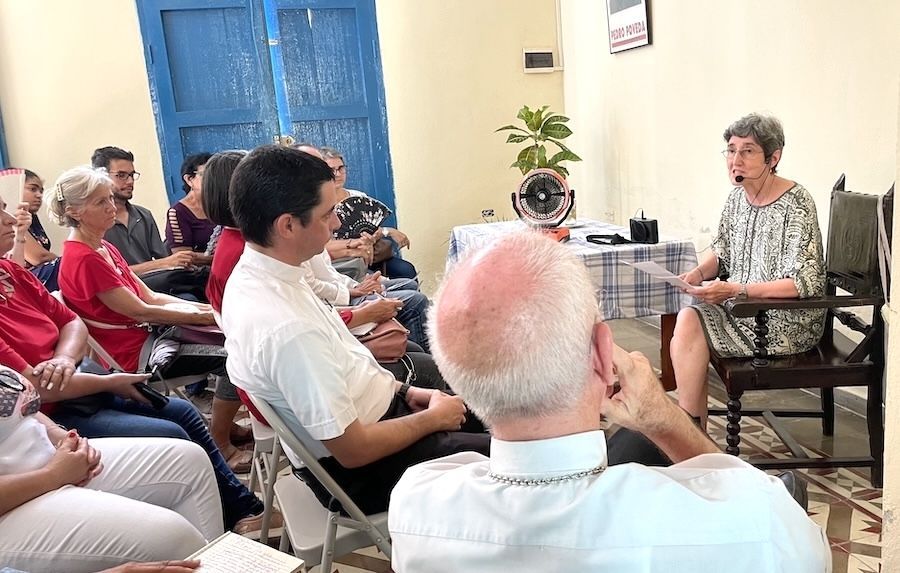
Holiness and Mission in San Pedro Poveda has been the theme that has brought together Catholics of the Diocese of Holguín, on the occasion of the Centenary of the Pontifical Approval of the Teresian Association.
“For Pedro Poveda, holiness is for everyone, without measures, it is not linked to a state or way of life,” said theologian Carmen Aparicio Valls during her conference at the Diocesan Library on July 20.
“Following Christ with a total and radical dedication is for every Christian,” the speaker reiterated before Bishop Emilio Aranguren Echeverría and Catholics of the diocese.
The theologian was in Holguín to begin the fourth three-year Biblical-Theological Course for the laity that the Teresian Association has been carrying out in the Diocese since 2010.
The heat and the lack of electricity were not an impediment for this event to take place, which is part of the activities organized on the occasion of the Centennial.
Throughout her lecture, the theologian developed the theme of holiness in the Old and New Testaments and offered quotations from the constitution Lumen Gentium of the Second Vatican Council. She indicated how the commentaries on these texts pointed out “as a novelty that holiness is the same for everyone, whatever the state of life or place in the body of Christ,” which recovers the sense of Christian holiness in relation to love.
For the speaker, these contributions go beyond the idea of holiness developed from the fourth century onwards, which marked the separation from the world, and had led to the identification of holiness with the so-called “state of perfection” of only members of religious congregations or priests.

Stages
Referring to Pedro Poveda, she analysed his writings according to the stages of his life, written between 1908 and 1936, which therefore, she indicated, some precede the Code of Canon Law of 1917 and all are prior to the Second Vatican Council.
Between 1911 and 1917 Poveda faced the challenge of outlining the type the traits to be lived by the those called to the Teresian Work that he had begun in 1911. “It is not only a matter of cultivating the interior life, but of uniting to it the evangelizing commitment, and not as two things superimposed, added or parallel, but integrated”, the speaker said. From these years, she said, “is a synthesis of the spirituality that he proposes to those who would carry out the T.A. Work: eminently human and entirely of God, according to the model of Saint Teresa. This synthesis must be sought in the Incarnation of Christ, where we find the sure norm to become saints.” As Poveda wrote:
The human perfected and divinized, because it was filled with God. The Incarnation well understood, the person of Christ, his nature and his life give for those who understand it the sure norm to become holy, with the truest holiness, being at the same time human, with true humanism. That being the case, we will be generous and our work will be attractive. Model? Saint Teresa of Jesus.
The speaker said that Poveda “will add a very beautiful nuance: holiness, which although it is one for all, is unique for each one, in the sense that holiness does not destroy, but respects the peculiarity of each person.”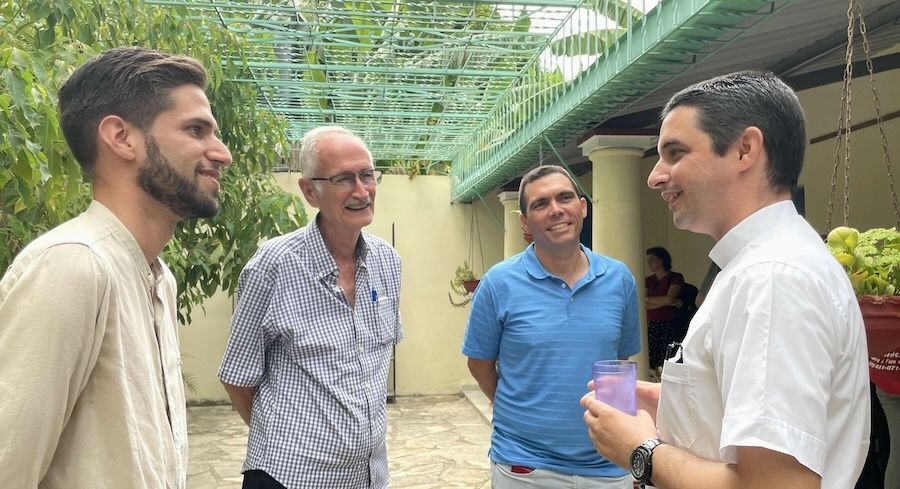
As Poveda wrote: “We can all copy from Christ, whatever our temperament, age, condition, sex and career, and by imitating him, we do not destroy our special way of being given by God, but we elevate and sanctify it.
Substantial form of the Theresian Assocation
Poveda, the theologian indicated, will be very radical by presenting the substantial form of the Theresian Assocation:
For me it is beyond doubt that the spirit is the first thing in our Work and not only the first, but the essential, that for which the Work must live, must have existence and must be a work of apostolate. But with the spirit I place knowledge and I consider that spirit and knowledge is the substantial form of the Association, that for which it is what it is and not something else, better or worse...
Poveda, said the speaker, “has given to ‘ordinary life’ the dignity of the ‘life of perfection’ because every Christian is called to perfection.”
She indicated that Poveda “has overcome the two extremes that have characterized the twentieth century: holiness as separation from the world, in the first half of the century, or holiness in the world but without God, in the second.
She believes that Poveda was preparing a path to return to the most genuine call that has characterized the Church always: the holiness of its members.
Araceli Cantero, Holguín (Cuba).
 Published in News
Comments will not be posted automatically, they are subject to moderation.
The email address WILL NOT BE VISIBLE in the comments section.