



The Friendship and Science Cultural Association (ACAC) is a social project run by the Teresian Association in Bolivia. It comprises three areas which are Radio CEPJA, Yachay Tinkuy, and Continuing Education. These areas share the common goal of socio-educational transformation, which they pursue through their respective fields. How have they managed to sustain their activities? What are their current needs?
ACAC is headquartered in Jaihuayco, a neighborhood in Cochabamba, in a three-story building that houses each of these spaces. Elizabeth Saucedo, a member of the TA team, has been in charge of its coordination for about 15 years. She says that she is very happy to be part of this TA social project because “it is meaningful work that responds to the needs of Bolivia” and says she is delighted with the teams that make it possible.
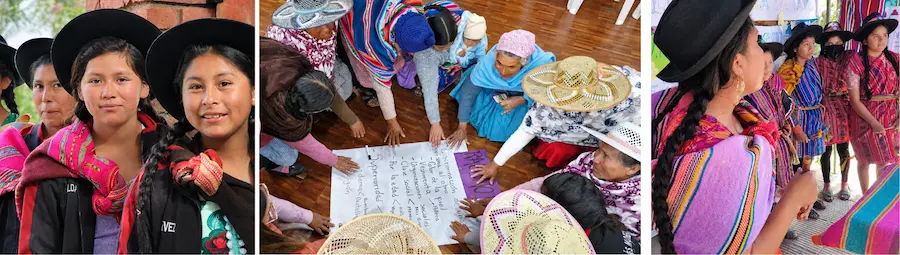
She said that much has been achieved because, although education has always been the priority, they have managed to go further because “The provincial authorities themselves recognize our work and in the assemblies they request the help of Yachay Tinkuy members in drawing up strategic plans (Annual Operational Plan, POA).”
The journey to get this far has not been easy. However, Elizabeth Saucedo has identified one of the key factors -- it is a job that requires a lot of dedication. This is what has defined each of the projects undertaken by ACAC. "We have managed to broaden our horizons considerably with the teachers and also with Radio CEPJA, which is currently one of the best-known Catholic radio stations in Bolivia."
Radio CEPJA
Sandy Guillén, its coordinator, is best positioned to tell us about the station's achievements. Radio CEPJA (the acronym stands for 'Centro Educación Permanente Jaihuayco' - Jaihuayco Continuing Education Center) gives a voice to working-class neighborhoods and the population of peri-urban areas, made up of migrants from indigenous communities in Cochabamba and other departments of the country like Potosí, La Paz, Oruro, etc.
“Through the radio, we support each of these communities,” Sandy Guillén continues, “promoting human development, working through citizen participation, providing useful information, and offering education. We give visibility to our neighborhoods by showcasing their cultural and linguistic diversity, since many people are Quechua speakers. We work with women, children, neighbors and youth organizations, and we also establish partnerships with other institutions to have a greater impact and increase our reach.” Ultimately, we give voice to those that are not covered by conventional media.
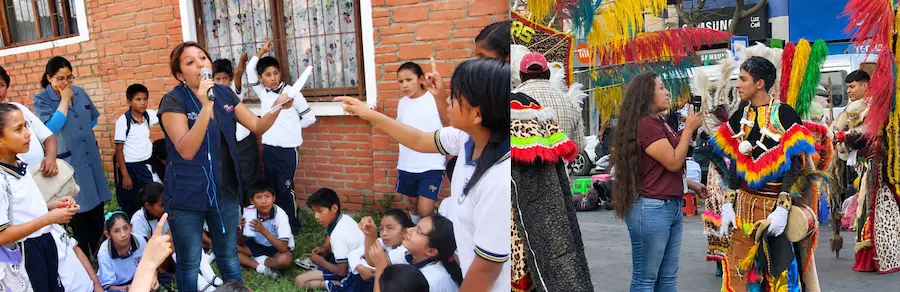
The listeners confirm this. Julieta, who lives in district 9 of Cochabamba, says it is a radio station that educates and helps families and young people especially to stay on the right path: "With the radio, I've learned about my rights and how to communicate better with my neighborhood and my family." Young Beatriz agrees: "It gives a voice to all communities without distinction and listens to everyone."
It is a unique radio station because it does not confine itself to the physical structure of the station and, moreover, it puts a face to each of its participants. They have programming and segments recorded in the studios, but they also have other programs produced in neighborhoods, schools and markets where interculturalism is paramount. They create informative magazines that promote citizen and social journalism, made in collaboration with local residents.
From the radio station's booth, young people also express their feelings, ideas, and initiatives, addressing diverse topics such as the promotion of democracy, human rights, and gender equality. All of this is combined with family guidance programs in collaboration with an organization of young psychology professionals. "In addition, there is programming linked to evangelization efforts, as we work closely with the Church, promoting Sunday services and other religious events in the neighborhoods."
Radio CEPJA is also dedicated to training: “We go to schools in southern Cochabamba and give communication workshops to strengthen leadership with groups of young people, children, women and neighbors. We are a school that opens itself to citizens.”
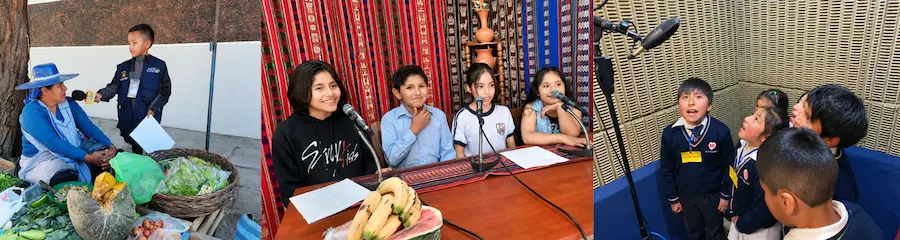
Taken together, this is what they call the 'edutainment' methodology, as it combines educational strategies and entertainment elements to address relevant issues in a way that is understandable, approachable and attractive to different audiences.
For Sandy Guillén, being at Radio CEPJA “is a daily challenge which involves continuing to improve, learn, work as a humane person, and encourage the people you work with every day. We are aware of the responsibility we have.”
Yachay Tinkuy
Yachay Tinkuy is another project of the Amistad y Ciencia Cultural Association. Its name is in Quechua and means "Encounter with Knowledge." Violeta Costas, its coordinator, explains that they carry out educational projects in rural and peri-urban areas where they work closely with socio-educational communities. These are the so-called dispersed areas, meaning rural zones within the municipalities of Anzaldo, Santivañez and Colomi.
“These communities are identified as Quechua, the predominant language. Most of these areas experience high migration and the few people who remain mostly work in agriculture or livestock farming. They have no resources of their own and depend on state funding. They are lacking in many areas -- not only in education but also in health and basic services,” explains Violeta Costas.
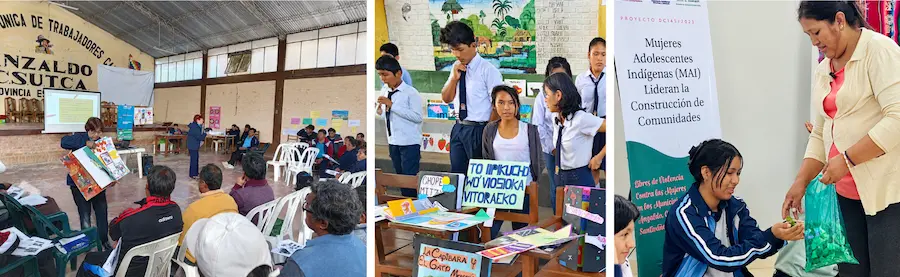
Yachay Tinkuy works on socio-educational projects with student councils and women's groups in the community. Dayaneira Chambi, vice president of the student council at the San José de Calasanz Educational Community and a member of Quechua Adolescent Women (MAQ), says that thanks to this initiative she has lost her fear of speaking and now expresses herself better in public. Ruth Castro, from the Women's Dialogue Circle, says that this space has become a place where they have learned to be more confident and to listen more.
They also collaborate with teachers, addressing curricular and pedagogical aspects while integrating other topics with a specific focus, and with educational authorities at both the district and municipal levels. “All of this is done while keeping in mind our established principles of intraculturality, interculturality, decoloniality, and depatriarchalization,” Violeta Costas clarifies.
The coordinator of this area at ACAC explains that one of her team's core tasks is to support each teacher's classroom work. “We realized that a workshop or training session that was not followed up often ended up being useless. However, with regular visits to schools through this support model, we achieve positive results in educational transformation.”
Juan Carlos Delgado, a teacher from the Moyini community at the René Barrientos Ortuño Educational Unit, affirms that the teacher training courses offered by Yachay Tinkuy have allowed him to foster the cognitive development of his students, both in reading comprehension and mathematical reasoning. Meanwhile, Edson Ambrosio Huarachi, director of the Andrés Moreno Siles Educational Unit, says that the Yachay Tinkuy program provides crucial socio-emotional support because many students are in vulnerable situations, have limited resources, and are sometimes orphans.
Continuing education
The third area encompassed by ACAC is continuing education. Its coordinator since 2019 is Hilaria Rodríguez, a member of the Teresian Association. Although she has worked as a teacher in the country's formal education system, she confesses that she enjoys dedicating herself to this other area of Bolivian education, since "popular education caught her attention from a very young age."
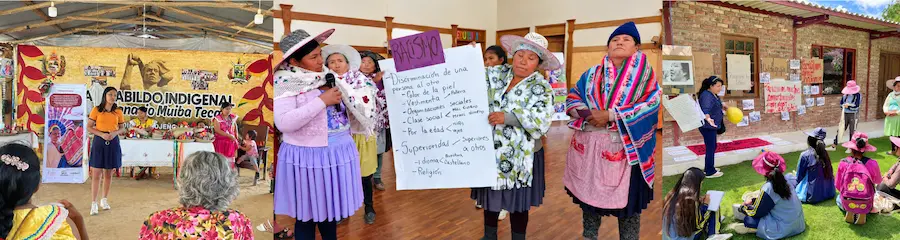
But what exactly is lifelong learning? Education in Bolivia is governed by Law 070, the Avelino Siñazi-Lizardo Pérez Education Law of 20 December 2010, which divides the education system into three subsystems: regular education, alternative and special education, and university education. Lifelong learning falls under the umbrella of alternative and special education. It is further divided into various sub-areas of study and is open to the entire population.
“It is education from life for life that aims to offer citizens more dignified living conditions. It is aimed at rural communities, social organizations, social movements, unions, neighborhoods, families and community centers. It takes place outside of schools, and its objective is the transformation of individuals and their environment. Until a few years ago, it was not well understood because it does not follow a fixed structure and is delivered according to the needs of those who request it,” explains the coordinator.
Furthermore, two or three years ago a service was launched to accredit people who practise a trade, possess extensive experience, but lack formal qualifications. Many of these individuals work in baking, shoe repair, construction and other trades, having learned their skills through knowledge passed down from one generation to the next; consequently, they lack official recognition. “This service consists of training workshops through which a certificate endorsed by the Ministry of Education is awarded, which carries significant academic weight.”
Despite some challenges in implementing these certifications, Hilaria Rodríguez affirms that this work “is truly beautiful.” She emphasizes that in the workshops, “the facilitators go to the corresponding rural areas and train people to make their own products and even foster entrepreneurship, teaching them, for example, where they can sell them.”
Challenges
The main challenge facing ACAC is funding. In the case of continuing education, teachers' salaries are provided by the State; however, the same is not true for the salaries of the Yachay Tinkuy and Radio CEPJA teams.
This year they have not received approval for any projects and have been able to survive thanks to the support of InteRed, the NGO of the Teresian Association. "We are waiting for a four-year project submitted to the Spanish Agency for International Development Cooperation (AECID) to be approved, which would give us some breathing room," says Elizabeth Saucedo.
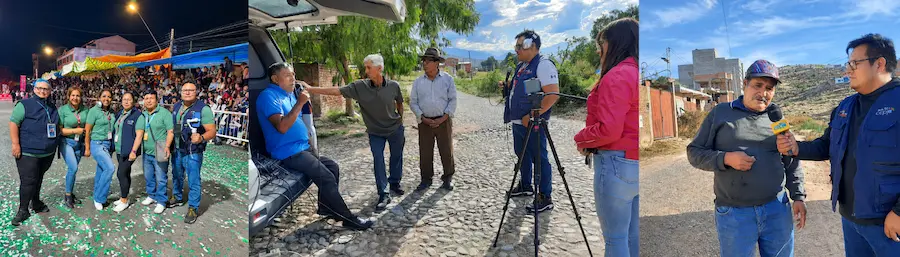
Although radio has various sources of funding, such as advertising, airtime sales, commercials and the production of other content, financial sustainability remains one of its main challenges. Bolivia's economic crisis has affected the demand for these services, and generally, the formulation and approval of new cooperation initiatives requires increasing effort and does not always guarantee the continuity of activities.
For all these reasons, we are always looking to diversify our sources of income and forge new alliances that contribute to the sustainability of these initiatives.
If you would like to get involved in these projects and help create life-changing education, you can find out more here.
TA Info.
TA translation team.
 Published in News
Comments will not be posted automatically, they are subject to moderation.
The email address WILL NOT BE VISIBLE in the comments section.