



The presentation of Magnifica Humanitas, the first encyclical of Pope Leo XIV, featured a contribution from Léocadie Wasbo Lushombo from the Democratic Republic of the Congo, a theologian, lecturer and member of the Teresian Association. The event, held in the Synod Hall, was attended by guests including Gregoria Ruiz, TA president, and Elisa Byamana Borauzima, also from the Democratic Republic of the Congo and a member of the TA in Italy.
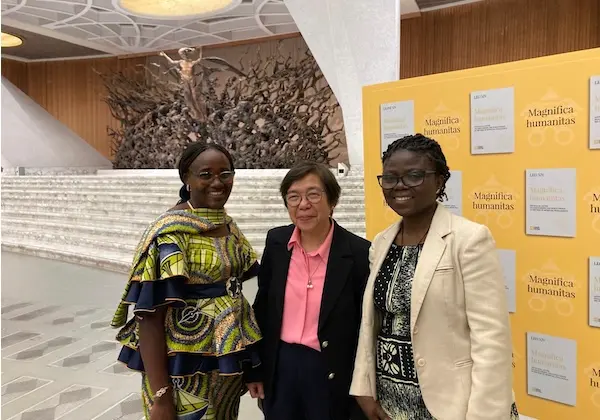
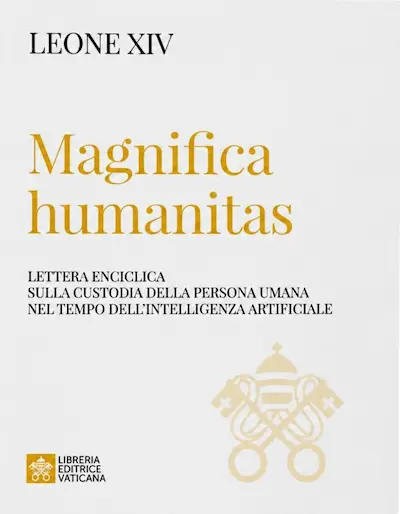
On 15 May 2026, coinciding with the 135th anniversary of the promulgation of Leo XIII’s Rerum Novarum, the current pontiff signed his first encyclical, Magnifica Humanitas. It is a social document that addresses artificial intelligence (AI), one of the great challenges of our time.
The official presentation took place on 25 May. It featured an address by the Pope – something that had never happened before – alongside prominent figures from various fields. Find out more about each address and access other resources to explore the encyclical further here.
Among the experts accompanying Pope Francis, Professor Léocadie Lushombo, a member of the Dicastery for Promoting Integral Human Development, focused her remarks on the warnings that the Pope issues in the encyclical regarding the effects of AI on conscience and the urgency of safeguarding the truth, protecting vulnerable workers and assuming shared moral responsibility. She also mentioned how it might affect the Global South and referred to the peoples of Africa, Asia and Latin America.
Throughout her presentation, she highlighted four concerns that the Pope reflects on in the encyclical. Discernment regarding human development is essential and we must deepen our understanding of Christian theological anthropology.
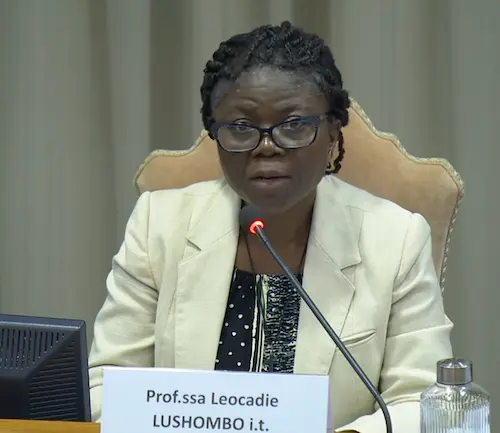
First of all, there is a need to safeguard our mind’s capacity to attain the truth. ‘The encyclical reminds us that machines cannot replace truth, and that we must find it within ourselves and in our relationships with others.’
The second concern was about the need to preserve inner freedom. The Pope reminds us that we must pay attention to digital platforms and how they are designed to monopolise users’ time and attention by exploiting their vulnerabilities and inner freedom. The document tells us that ‘if we delegate our judgements to machines, we will cease to seek the whole and limit ourselves to knowing only partial aspects.’
Truth is relational
The third point focuses on clarifying that truth is relational. Data and facts are subject to verification, cross-checking of sources and argumentative accountability. Knowledge is relational and communal. In this context, the lived experience of each individual is fundamental. Likewise, we are reminded that the poor tell us what the world is and what the service of the Church in it should be. ‘They awaken our conscience; they are an embodiment, like all of us, of a magnificent humanity.’
She emphasised that our true frames of reference emerge from lived intercultural and inter-contextual relationships, something difficult for AI to achieve. She also highlighted that ‘we learn best when we are encouraged to trust in our own abilities.’ She then took us on a journey through the community cultures of Africa, Asia and Latin America, where, through various rites and customs, an emotional connection is forged, mutual support is provided between communities, and heavy burdens are shared.
Click on the video to watch the presentation.
‘Human beings exist in a symbiotic relationship, affirming the self as a world beyond a materialistic approach centred on efficiency and accumulation. That is why Magnifica Humanitas calls on the Global South not to lose these values as a result of AI, which can cause learning to become an isolated and transactional process rather than being community-based and ideological. AI can be highly colonial because it affects creativity and the collective imagination; it stifles the desire to ask questions.’
 Finally, she mentioned the protection of workers. AI is widening the gap between workers in developing countries. ‘We must look beyond GDP and we must deconstruct technology. This does not mean abandoning it, but using it as a means rather than an end. Otherwise it widens the gap between rich and poor and follows the patterns of economic globalisation.’ She further noted that the suffering of workers in these production chains goes unnoticed, and we must not forget that protecting workers’ dignity is key.
Cardinal Pietro Parolin chaired the presentation, which featured contributions from Cardinals Víctor Manuel Fernández and Michael Czerny, the co-founder of Anthropic, Christopher Olah, and Anna Rowlands, a theologian from the University of Durham in England, as well as Léocadie Lushombo.
Info TA.
 Published in News
Comments will not be posted automatically, they are subject to moderation.
The email address WILL NOT BE VISIBLE in the comments section.