



With the title Marginality, resistance and creativity in early Christianity, Professor Elisa Estévez López gave her last lecture at the Faculty of Theology of the Universidad Pontificia Comillas (Madrid) on 5 December.
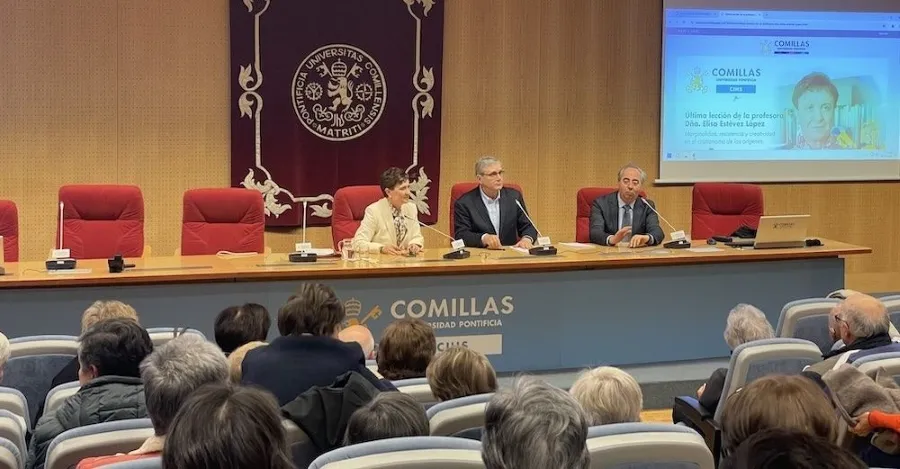
The ultima lectio is a special rite of passage in the university community, an open and moving act in which students, faculty, friends, relatives... join in listening to the lecture of a professor before his or her retirement. Professor Elisa Estévez, member of the Teresian Association and member of its Governing Council, has thus culminated twenty-seven years of dedication to teaching in her speciality of Biblical Sciences, in the Faculty of Theology at Universidad Pontificia Comillas.
Elisa Estévez holds a PhD in Theology from the Universidad de Deusto (Bilbao) and a degree in Biblical Sciences from the Pontifical Biblical Institute (Rome). She has taught various subjects at Universidad Pontificia Comillas since the 1996-97 academic year and has also been a visiting lecturer at several Latin American universities. A tireless researcher, she has published extensively and has been president of the Association of Spanish Women Theologians (2001-2006), among many other activities in her fruitful career, beyond her time as a university lecturer.
 Vocation
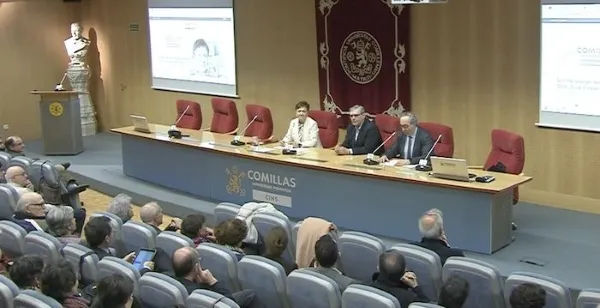
Elisa Estévez was accompanied at the table during the ceremony by the Rector of the University, Antonio Allende Felgueroso SJ, and Francisco Ramírez Fueyo SJ, Dean of the Faculty of Theology and Canon Law, who opened the session with a summary of Elisa's career as a teacher and researcher. He stressed that teaching in the field of theology is not just a job, but a vocation, which involves transmitting knowledge, values, faith, and a vision of the world enlightened by the Word of God.
 Marginality
Elisa developed the theme "Marginality, resistance and creativity in early Christianity", specifying that the notion of "marginality", coming from sociology, is not identified with exclusion, but with a way of being in the world consciously chosen by the Christian groups of the first centuries.
“Living as outsiders in the various parts of the Roman Empire was a mark of identity of these early Christian communities”, she said, describing their characteristics, values and also the conflicts they experienced.
She went on to say that “In the early communities, we find keys that can illuminate how to be citizens and believers in today's societies”.
Apart from students, teaching staff, family and friends, a large group of members of the TA accompanied Elisa Estévez in this lecture, undoubtedly not the last, although it was one of the most significant and very warmly applauded. The full text of the lecture was handed out to the attendees edited by the University's publications service.
TA Info.
 Published in Outstanding
Comments will not be posted automatically, they are subject to moderation.
The email address WILL NOT BE VISIBLE in the comments section.