



“Education as the foundation and driving force for social transformation and full human development. Inclusion – Inner Life – Innovation – Equity – Sustainability – Global Justice – Citizenship – Peace” was the theme of reflection addressed by the Teresian Association’s Council for Culture, held from 21 to 29 July 2026 at Santa María de Los Negrales.
 The gathering offered an in-depth exploration of the various dimensions of education as a means of promoting and strengthening the fundamental values of inclusion, inner life, equity, and sustainability in the pursuit of global justice, responsible citizenship, and peace. These themes were examined through a process of discernment in light of the priorities and recommendations of the 2023 Teresian Association General Assembly, as well as Pope Leo XIV’s encyclical Magnifica Humanitas.
Inclusive education
The intensive programme covered a broad range of topics, including educational policies with a particular focus on inclusive education looking toward 2040; the promotion of communication and dialogue through digital platforms; the impact of Artificial Intelligence (AI) on education, society, and interpersonal relationships; and the development of interpersonal and emotional competencies.
This session featured João Costa, Chair of the OECD Committee on Educational Policy and the Global Forum on the Future of Education and Skills 2040 and, since 2025, Director of the European Agency for Special Needs and Inclusive Education. His presentation was particularly insightful and thought-provoking.
The opening conference, “Education Policies towards 2040 and Inclusive Education,” brought together educators and professionals from various fields who have contributed to the Council for Culture’s ongoing work in education.
João Costa, a researcher specialising in theoretical syntax, language acquisition and development, and educational linguistics, highlighted how today's context—marked by uncertainty, complexity, and the volatility of relationships—presents unprecedented challenges for educational and inclusive education policies. He stressed that these policies are fundamental to the future of society, social cohesion, and democracy itself, with a view toward building a shared future.
Looking ahead to 2040, inclusive education should serve as the foundation of high-quality education systems by identifying and removing barriers to learning and participation, fostering a strong sense of belonging, and creating systems that respond to the diverse needs of every learner.
Designing inclusive teaching practices, building authentic educational communities, and investing in the continuous professional development of educators—particularly by strengthening their interpersonal and emotional competencies—are among the essential pillars of a new era of education, one that serves as the foundation and driving force for social transformation and the full development of every person.
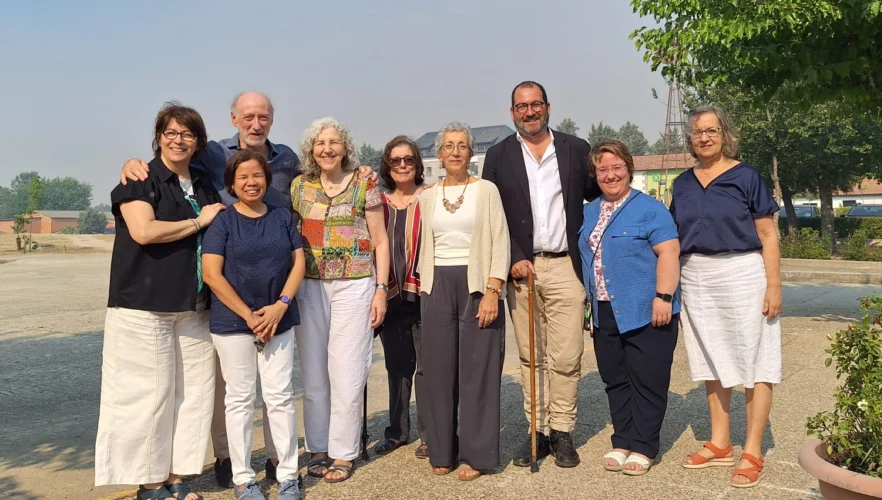 Mariana Facciola, Carmelo Coco, Rudelyn Demerin, Inmaculada Balfagón, Lola Morillas, Lurdes Figueiral, João Costa, Mónica González and Rose Miró.
Intelligences
In the same spirit, Antonia Martín Sánchez, a psychology researcher at the Pontifical University of Comillas whose work focuses on mental health, holistic development, and spirituality, offered a profound reflection on Spiritual Intelligence (SI) and its essential integration with Emotional Intelligence (EI). She explored the competencies associated with SI, the relationship among the different forms of intelligence, and the importance of recognizing in each person an authentic and profound transcendent experience as a path to psycho-spiritual and relational growth, both personally and within the community. She is the author of Cultivar la Inteligencia Espiritual: un itinerario de crecimiento psicoespiritual y relacional (Narcea, 2026).
The relationship among the different forms of intelligence, the development of inner life, and Artificial Intelligence—with a view to fostering a more human-centred digital world, particularly within educational settings—was the focus of the presentation by Inés Gómez Chacón, lecturer and researcher in Mathematics Education at the Faculty of Mathematical Sciences of the Complutense University of Madrid. She is also the co-author, with Steven Van Vaerenbergh, of Inteligencia artificial y profesorado: cuestionar, comprender e integrar la IA en el aprendizaje (Narcea, 2026).
Inés Gómez Chacón invited participants to reflect on why the power and influence of AI and intelligent systems should never be accepted without critical examination or appropriate regulation. From a humanistic perspective, she challenged participants to ask what fundamentally distinguishes a human being from a machine. She also emphasised the uniquely human dimensions of action, thought, and existence that educational contexts must continue to cultivate in both teaching practice and everyday life in this new era of artificial intelligence.
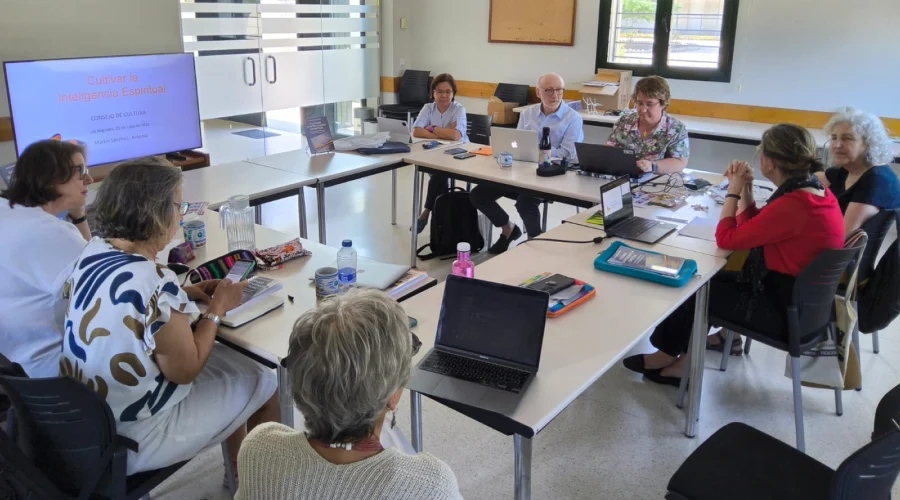 Workshop with Antonia Martín.
Urgent renewing
In conclusion, these presentations reaffirmed that the commitment to renewing education is more urgent than ever for the Teresian Association wherever it is present. They call all members to embrace the educational mission with renewed conviction and dedication, rooted in an incarnate vocation and inspired by the desire to contribute to social transformation,
‘… a style of presence and a passionate mission, to rebuild trust, … in the conviction that education is the new name for peace’ (Pope Leo XIV).
The final two (2) days of the meeting were dedicated to finalizing the Education document, which is scheduled for launch at the end of 2026. The days of seminars, dialogue, and collaborative work undertaken by the members of the Council for Culture were both fruitful and enriching. Throughout the meeting, the Council was accompanied by Lurdes Figueiral, the liaison of the Governing Council, whose presence and guidance greatly contributed to the group's reflection and work.
Council for Culture.
 Published in News
Comments will not be posted automatically, they are subject to moderation.
The email address WILL NOT BE VISIBLE in the comments section.