



Members of the TA in Chile and representatives of the Association's schools in the country celebrated their annual festival in commemoration of the canonisation of Saint Pedro Poveda. This year, the festival also marked the conclusion of the celebrations for the hundred years of Pontifical Approval. This chronicle tells us how the event unfolded.
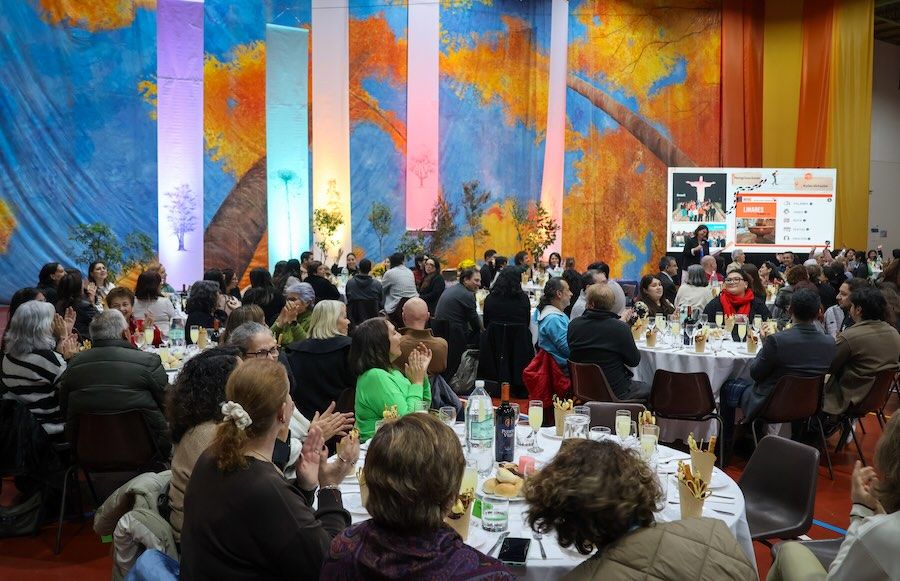
On Friday evening, 9 May, representatives from the Teresa Brown de Ariztia school in La Calera, the Alberto Pérez school in Maipú, the Institución Teresiana school in Las Condes, and members of the Teresian Association from both associations gathered.
Eliana Corbett Godoy, sector director of the TA in Chile, gave a welcome address:
«Twenty-two years ago, on 4 May 2003, Pedro Poveda was canonised, and since then, we have come together to celebrate this achievement, strengthen our community bonds, and renew our commitment to creating a better world.
This year, with grateful hearts, we are closing the centenary of the pontifical approval of the Teresian Association. Gregoria Ruiz, the TA's President, told us that 'this celebration has awakened renewed energy to value our vocation, commit ourselves to the mission, and share the charism'.
This closing also invites us to give thanks for this privileged moment in time, and for the election of Pope Leo XIV. This event raises questions about the future, and fills us with hope regarding the leading role of the laity and the future of the Church. We are delighted that his name has such strong historical significance, reminding us of Leo XIII, the Pope who, in 1891, issued the encyclical Rerum Novarum — the first document to address workers' rights and social justice, thus laying the foundations for the subsequent development of the Church's social doctrine.»

«The Letter of the Year calls on us to be pilgrims and protagonists of the community. This afternoon, we will pause along the way and take an active break to renew our bonds of brotherhood. We are accompanied by the image of the tree. For pilgrims, it is a place to share food and rest. The tree reminds us that we are not walking alone, but as a family and a community. Tonight's dinner nourishes our dream of creating a fairer, more inclusive and supportive world. I invite you to join me in raising a toast to begin our celebration.»
After the welcome, we blessed the table and lit a candle to signify the presence of the Risen One — the warmth that brings us together and the light that guides us on our journey. We asked the Lord to bless the dinner and gave thanks to those who had prepared the food. We then took time to introduce ourselves at each table while enjoying a delicious appetiser.
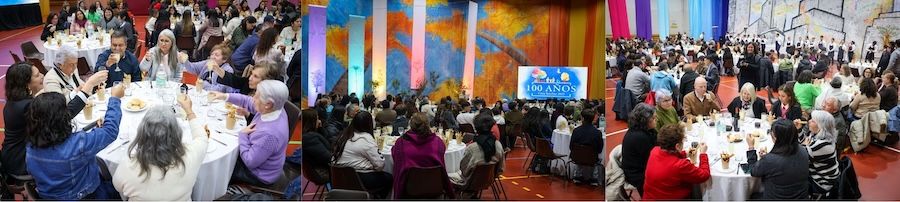
Later, while we were having dinner, we were invited to discuss two questions focused on communion and unity.
- Where do I think communion is needed in Chile today?
- What experiences have we had of overcoming challenges thanks to unity?

At the end of our gathering, we gave thanks through a representative from each community.
As our meeting came to a close, we realised that sharing that evening was a way of sharing a charism that invites us to open our communities, inviting others to seek meaning and contribute to building a fairer, more inclusive and supportive world.
Together, we watched a video of the celebrations experienced by TA Chile during this centenary year.
To conclude the celebration, we were given a set of cards bearing quotes from Saint Pedro Poveda. These were created by Cecilia Arancibia to commemorate the centenary. They were a way of giving thanks for this year.

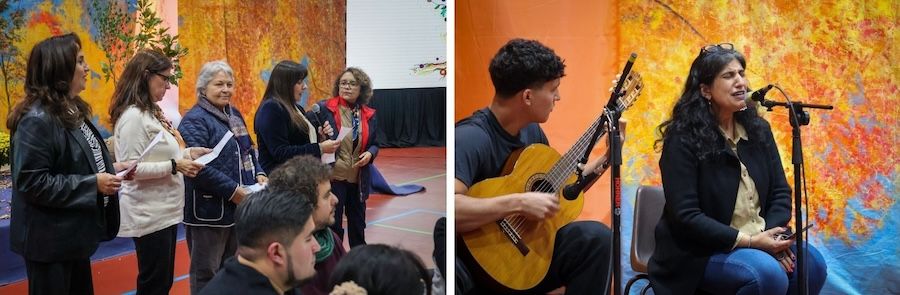
As we close the first centenary of Pontifical Approval, we can say with certainty that we look forward with confidence, knowing that the seed sown continues to bear fruit. We also look at our present with gratitude for the life of Saint Pedro Poveda and for everyone who has made this journey possible.
Those of us gathered here today, as well as those who will follow, must think, dream and move forward towards 2028, the year of the first centenary of the TA in Chile. Life remains open to the future.
Cecilia Arancibia, Tere Ormazábal. Chile.
Original text in Spanis, translated by TA Info with help of AI tools.
 Published in News
Comments will not be posted automatically, they are subject to moderation.
The email address WILL NOT BE VISIBLE in the comments section.