



The Teresian Association in Catalonia closed its centenary celebrations with a lecture given by Elisa Estévez, a member of the Teresian Association and its Governing Council, at the Centre for Contemporary Culture in Barcelona (CCCB).
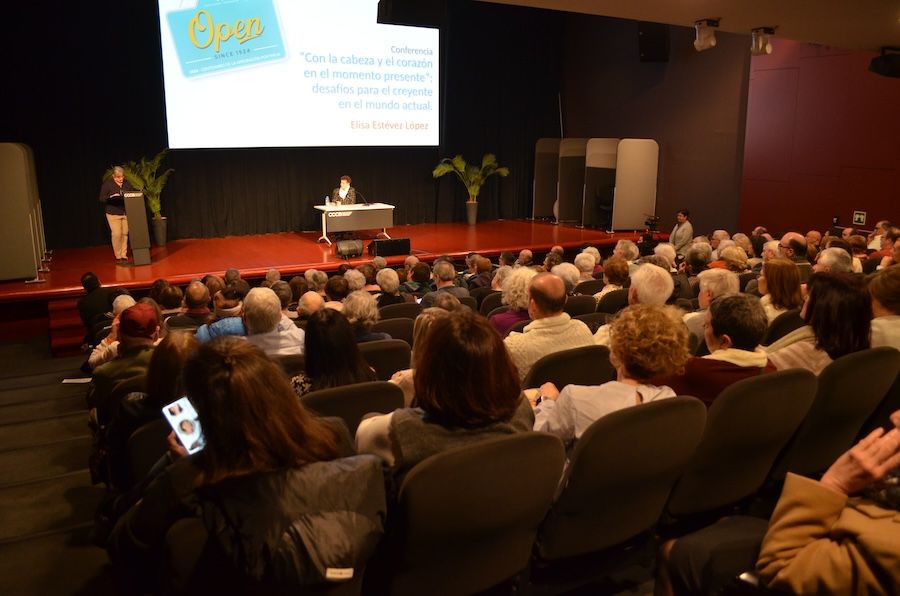
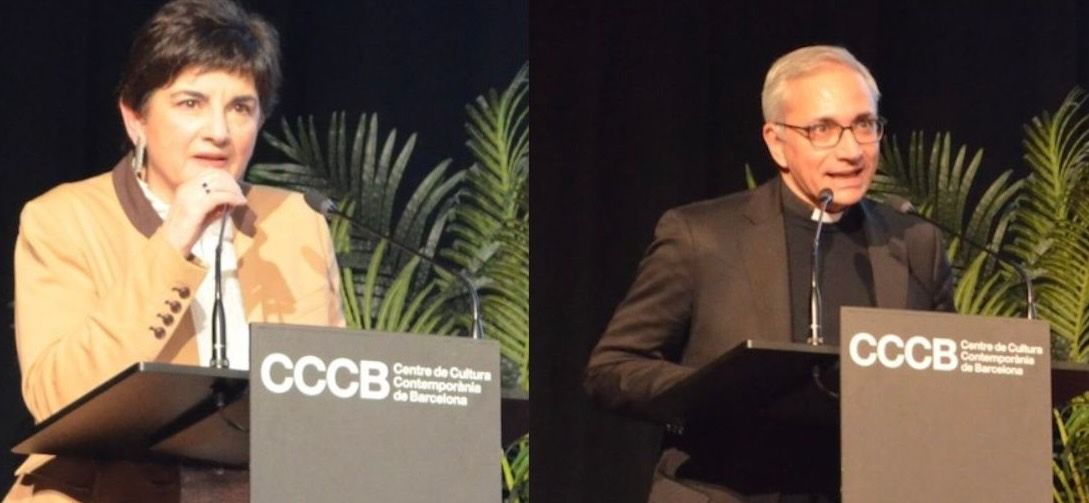
Also present at this event, held in Barcelona on 11 January, were Mª del Carmen Aragonés, Sector Director of the TA in Spain, and Emili Gil, Pro-Vicar of the Archdiocese of Barcelona, representing Cardinal Juan José Omella.
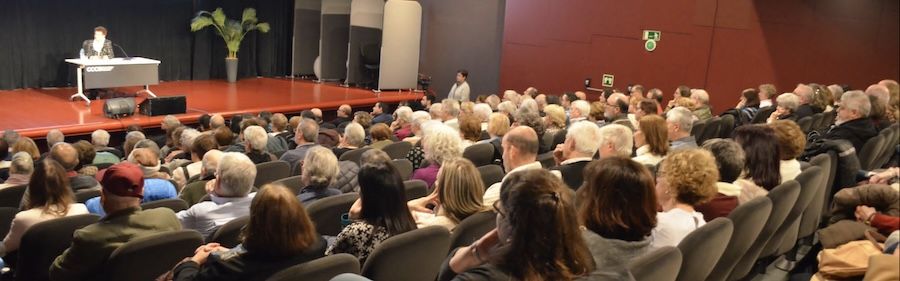
The venue was packed, waiting for the theologian and university professor Elisa Estévez to begin her lecture entitled: ‘With mind and heart in the present moment: challenges for believers today’.
Her first words referred to the end of a year full of celebrations in which the Teresian Association has given thanks for what the charism of Pedro Poveda has embodied in the different realities of the four continents where it is present. ‘We have seen how the fruits that Pedro Poveda spoke of are bearing fruit. It is a joy.’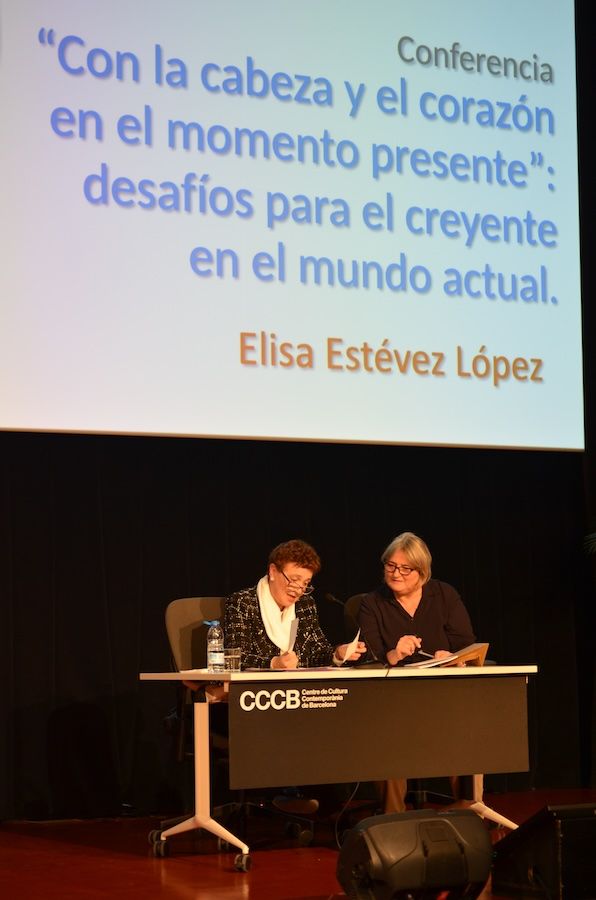
The here and now
She then began her speech with a quote from Ernesto Sábato: ‘Life only needs the space of a crack to be reborn’. Something, according to the theologian, that is not easy to recognise.
This is because, among other things, we live immersed in the categorical imperative of well-being, happiness and optimism, as well as being subjugated by the performance-oriented society. However, it is necessary to live fully in the present moment: the here and now. In other words, to live connected with the presence that dwells within us.
‘The words of Pedro Poveda: I, whose mind and heart are in the present moment, provide the appropriate framework for us to ask ourselves about the current challenges facing those of us who believe in Jesus,’ said Elisa Estévez, explaining the title and meaning of her presentation.
‘We must live in the here and now, filling it with love, and not live in exile, uprooted, scattered or distracted. The most beautiful certainty is the present moment, if we live it in the fullness of God. Poveda said that we had to focus on doing ordinary and everyday tasks well. And she emphasised that the ordinary should be lived in an extraordinary way,’ she continued.
Sentient intelligence
At the same time, the theologian assured that those who follow Jesus must enter into reality with a sentient intelligence in the face of each person's situation: ‘The challenges that believers face and that are imbued with that intelligent feeling are full of hope.’
She also emphasised that we are called to practise a contemplative gaze, which is not based solely on looking but also on allowing ourselves to be looked at by reality and by those who live on the periphery. In fact, she highlighted the importance of focusing on the senses: seeing, touching, looking... because today our sensitivity is atrophied because societies avoid anything negative, among other reasons.
She focused on the senses of sight and hearing. Both must be vulnerable: ‘Let us allow ourselves to be affected, hurt, by those who suffer loneliness, injustice, exclusion...’ All this implies a conscious decision to stop and pause with people on a constant basis. ‘Contemplative practice is attentive listening to each person and each reality,’ she clarified. She also spoke of silence, which is necessary to distance ourselves from urgencies.
Different and more humane
She revisited the idea that we are witnessing an ‘extraordinary’ distinctiveness. “Faith helps us. We must dare to be different. As Pedro Poveda said, to live like everyone else, but differently.” She emphasised the idea that uncertainty is an opportunity that invites us to think beyond the established norms.
She also insisted on the fact that being more human is at odds with individualism: “We need each other. Becoming fully human is a communal task, not an individualistic one. To do this, we must set aside the everyday selfishness so common in today's society, accept responsibility, cultivate interdependence to foster more just societies, and firmly believe that the other is a free being.”
In short, Elisa Estévez insisted that it is necessary to cultivate solidarity and hope, to care for everyone – which also means taking action – and invited those present to get involved and take an interest in life. She encouraged them to look to the future so that they could make their dreams come true. She suggested creating a positive mindset and connecting with the best future situation that each person wants to achieve.
After the lecture, the theologian and university professor answered several questions from the audience. The event closed with a brief speech by Carmen Aragonés and Emili Gil.
To watch and listen to the full lecture, CLICK HERE.
TA Info.
TA Translation Team.
 Published in News
Comments will not be posted automatically, they are subject to moderation.
The email address WILL NOT BE VISIBLE in the comments section.