



The annual meeting of leaders of international associations of the faithful and ecclesial movements organised by the Dicastery for Laity, Family and Life was held in the Vatican on 13 June.
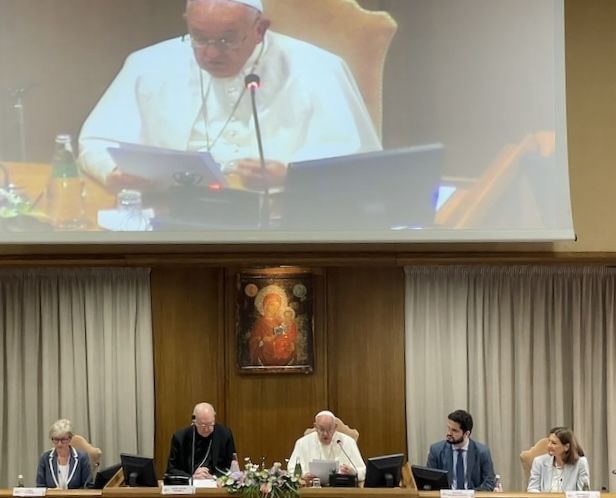
“My hope is that following this Synod, synodality may endure as a permanent mode of working within the Church, at all levels […] until it becomes a shared ‘ecclesial style”.
These words were spoken by Pope Francis in his audience on 13 June 2024 with over two hundred people attending a meeting called by the Dicastery for Laity, Family and Life. It is an annual meeting with the moderators of international associations of the faithful, movements and new ecclesial communities. As three people from each association were allowed to attend, the TA president, Gregoria Ruiz, was accompanied by the vice-president, Maria Rita Martín, and the general secretary, Rosario Marín.
The challenge of synodality for mission was the topic chosen this year. The pope addressed the participants in the New Synod Hall and emphasised the need for true conversion in order to achieve this synodal “ecclesial style”. He pointed out three attitudes for this spiritual conversion: to think as God thinks, to move beyond exclusiveness and to cultivate humility. “The starting point of spiritual conversion must be humility, the gateway to all virtues”, the pope said, adding, “only the humble person esteems others and welcomes their contribution, advice, inner richness, bringing out not their own ‘self’, but the ‘us’ of the community.”
At the end of the audience, all participants were able to greet Pope Francis personally. His full message can be read here.
It remains a challenge
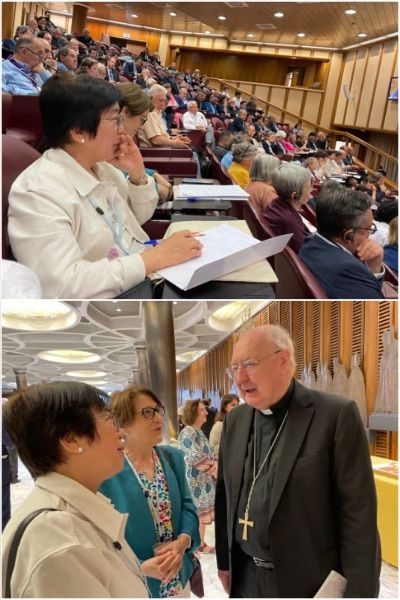 The meeting continued with an introduction by the prefect of the Dicastery, Cardinal Kevin Farrell. He said that the Synod on synodality was not convened to deal with ‘topics’. “At the heart of the Synod is synodality itself, as a way of being of the Church.” On the theme chosen for the meeting, he invited us to “reflect on the origin and nature of this link between synodality and mission that is lived out in the movements”. He added that “to live synodality for the sake of mission remains a challenge... it is easy to return to individualism, to slip into abandoning synodality and our faith lived together, the ecclesial journey. It is also easy to lose missionary focus because our personal comfort and a quiet life can prevail... as well as conforming to the way the world thinks, to fear and resignation, to doing things the way they have always been done, etc.”
This was followed by two presentations. The first, entitled “Towards a constitutively synodal and missionary Church: Synodality is missionary and mission is synodal”, by Rafael Luciani. He is a professor at the Andrés Bello Catholic University of Caracas in Venezuela and one of the experts appointed to the Synod. He gave an in-depth study of the People of God category and how we can go forward in the epochal transition that must be made by the Church.
The second talk was given by Elisa Lisiero, an official in the Dicastery. She presented the experience of the movements and associations with synodality by drawing on the contributions sent to the Dicastery in 2022 for a synodal consultation during the first stage of the Synod. It addressed, among other issues, structures and practices in the movements and associations that support the synodal journey.
Emphasis on the transmission of the faith
After lunch, the meeting continued with time for open dialogue with the speakers and free interventions by some of the more than two hundred participants from ninety-five lay associations and movements of the universal Church. They shared experiences of synodality and issues about church groups that have not yet taken seriously Pope Francis' commitment to synodality in the Church.
At the end of the meeting, Cardinal Farrell, in his concluding remarks, emphasised transmission of the faith and how the movements and associations must carry out this evangelisation in communion with the local Churches.
This meeting with moderators –the people who lead or preside lay associations and movements– is organised every year by the Dicastery for Laity, Family and Life. It is an opportunity for exchange between the associations and the Dicastery. The undersecretary of the Dicastery, Linda Ghisoni, pointed out to Vatican News that this year there was a record number of participants, with more than 220 people –including 80 leaders– from 95 lay organisations from all over the world, of the 117 recognised by the Holy See. In a few months' time, a volume will be published with the papers and speeches that will accompany the reflection of the members of this varied range of ecclesial groups recognised by the Dicastery for Laity. A summary of the papers can already be accessed on the website of the Dicastery.
TA Info.
TA translations Team.
 Published in News
Comments will not be posted automatically, they are subject to moderation.
The email address WILL NOT BE VISIBLE in the comments section.