


The Teresian Association has been a member of the non-governmental organisations with consultative status with ECOSOC (the UN Economic and Social Council) since 1998 and, as such, has maintained a fairly consistent presence at events relating to the themes chosen over the years: the right to education, the right to development, women, young people and migrants, with these events taking place alternately in Geneva, New York and Rome.
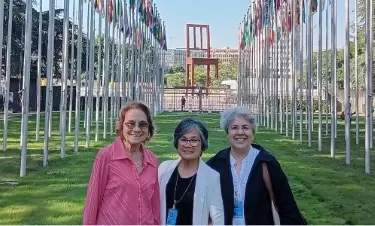 As part of the new team formed last year,Inés Carbajal, Matet Gayondato and Mary Larrosa took part in the 62nd Session of the Human Rights Council in Geneva (Switzerland) on 17, 18 and 19 June, during which issues relating to the right to education, international solidarity, and freedom of expression and opinion were discussed.
Of the many events taking place at the moment, some are plenary sessions in which member states and civil society representatives take part in interactive discussions, whilst others are so-called side events – smaller meetings organised by various stakeholders to focus on a specific topic.
After attending an interactive dialogue on Human Rights and International Solidarity, which gave us a broad overview of the subject, we decided to explore three areas in greater depth: freedom of expression and opinion, the right to education, and human rights education.
With regard to the first item, we attended an interactive dialogue amongst member states during which the report by the Special Rapporteur, Irene Khan, was considered. Broadly speaking, the report and the statements made by member states revealed a clear consensus amongst all participating countries on the value of this inalienable right and the need to safeguard it. In practice, however, the report contained observations on situations of risk and persecution faced by journalists and dissidents in conflict zones. The countries in question were able to exercise their right of reply, and many did so; nevertheless, the situation was raised in this international forum as a cause for concern and a focus of attention.
There were also numerous contributions from the floor on the threat posed by artificial intelligence used to spread fake news and manipulate information, and on the inappropriate use of social media.
With regard to the right to education, the most significant discussions centred on two documents:
- Progress towards the educational goals of the Optional Protocol: Accessible and pluralistic education was promoted. The right of families to choose was emphasised, as was the importance of education that is purposeful, reflects cultural identity and is free from state monopoly.
- Farida Shaheed’s (UN) Annual Report1: Emphasises relevant curricula, coherent teaching methods and formative assessments. Recognises students, teachers and families as rights-holders. Highlights emotional well-being, creativity and the preservation of cultural identities, particularly those of minorities.
- Informal session with the Special Rapporteur: First meeting with NGOs to discuss the report. It facilitated a productive exchange on its implementation in different countries.
- Event on human rights education (GO-HRE, Geneva Office for Human Rights Education): The World Programme (5th phase) was presented, focusing on youth, technology, the environment and gender. Proposals and experiences were shared to improve its implementation.
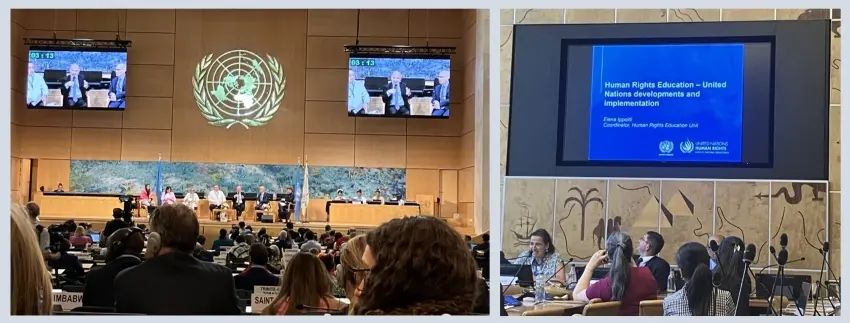
To conclude, we took part in the high-level debate marking the 20th anniversary of the Human Rights Council, where the progress made in youth inclusion — reflected in the participation of Malak, a Jordanian youth —, the climate of trust and the consensus reached were highlighted. The importance of strengthening collaboration with civil society to promote and protect human rights was also emphasised.
An enriching and educational experience
For us, these have been days of great enrichment and learning. A window onto the world, with its achievements and areas of progress, but also a greater awareness of the major threats looming over the entire human rights system, which risk setting it back.
The United Nations and the values of the Gospel share common principles, particularly with regard to human dignity, peace and care for our common home. Whilst the UN provides a framework for global cooperation, the values of the Gospel, as well as those of other spiritual traditions, offer a moral and ethical foundation. It is encouraging to see this connection in the fields of humanitarian aid, social development and peace-building.
We reaffirm the importance of our presence as the Teresian Association in these forums, helping to make the voice of civil society heard and to foster reflection and commitment as a concrete way of being salt and light in public life.
Inés Carbajal, Matet Gayondato and Mary Larrosa.
TA Translation Team.
_____________
1The survey captures the views of children and young people on education. It summarises 302 responses from a variety of educational, social and geographical backgrounds, and analyses what pupils value in education, whether education prepares them for life, and how they believe teaching, learning and assessment should be transformed. The recording of Farida Shaheed’s report from 1:04’ to 1:10’.
 Published in News
Comments will not be posted automatically, they are subject to moderation.
The email address WILL NOT BE VISIBLE in the comments section.